



War Propaganda
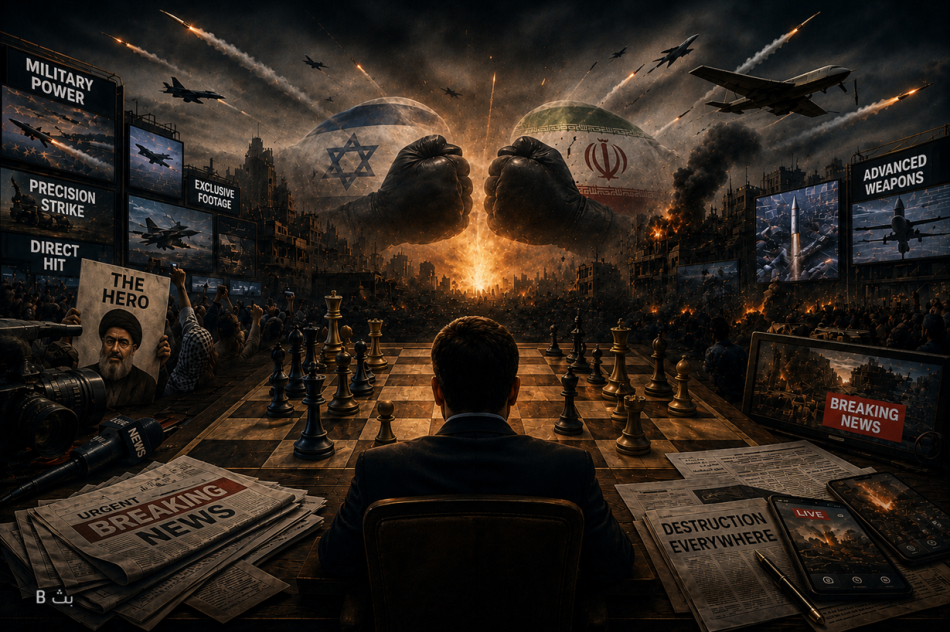
By Abdullah Al-Omairah
In the Arabian Peninsula, elders often repeat an old Najdi proverb:
"Half of war is noise."
Sometimes it is narrated in a slightly different form, but the meaning remains the same.
The proverb does not refer to combat itself.
It refers to the noise surrounding it:
Display.
Exaggeration.
Loud voices.
And convincing the opponent that your strength is greater than it actually is.
It is an early description of what we now call:
Psychological warfare.
Long before television channels existed.
Long before social media platforms appeared.
And long before military institutions established specialized departments dedicated to shaping perception.
This is why experienced elders used to say:
"The ancestors left nothing for those who came after them."
Many of the concepts we see today under modern names have existed for centuries under different ones.
The War That Is Broadcast Before It Is Fought
Modern wars do not begin with gunfire.
They often begin with a narrative.
Before a missile, there is a statement.
Before an airstrike, there is a leak.
Before an explosion, there is a camera.
Every side seeks to win in the minds of its audience before winning on the battlefield.
That is why the struggle is no longer simply between two armies.
It is between two narratives.
Two images.
And two competing levels of exaggeration.
Between the Missile and the Noise
While following the latest confrontation involving the United States and Israel on one side and Iran on the other, I found myself recalling that old Najdi proverb.
Within hours:
Missiles from one side.
Airstrikes from the other.
Mutual threats.
Endless statements.
And a nonstop media storm.
Yet when one looks beyond the noise and focuses on actual outcomes, a different question emerges:
Does the impact justify the noise?
Or has the noise sometimes become larger than the event itself?
I do not underestimate the dangers of war.
Nor its political and military consequences.
But I am speaking about another phenomenon:
War propaganda.
The kind of exaggeration that makes a handful of missiles appear as though they will change the world.
And makes certain strikes appear as though they have decided the outcome of the conflict.
While the war continues the next day as if nothing decisive has happened.
A Different Kind of Wrestling
At times, the scene resembles a wrestling arena.
But not traditional wrestling.
More like a contest of slaps.
A strike here.
A strike there.
Loud sounds.
Excited crowds.
Endless noise.
Yet the decisive moment never arrives.
Some missiles travel hundreds of kilometers.
And dominate television screens.
Yet their actual impact may be far smaller than their psychological effect.
Meanwhile, Israel carries out more painful military strikes.
Yet they do not end the problem.
They do not eliminate missile capabilities.
And they do not stop the confrontation.
The questions therefore remain:
Where is the decisive victory?
And where is the overwhelming power everyone talks about?
The Audience That Gets Drawn In
The problem is not limited to armies.
It also involves the public.
Psychological warfare does not target enemies alone.
It targets spectators.
Their emotions.
Their dreams.
And their desire to see a heroic figure winning on their behalf.
This is why many people across the Arab world have, over the years, viewed certain militia leaders as legendary heroes.
Missiles are launched.
Fiery speeches are delivered.
Portraits are hung on walls.
Yet one question is often missing:
Who will pay the price?
In many cases, the cities producing the slogans are not the ones receiving the strikes.
Nor are the loudest voices the ones bearing the cost of destruction.
The burden falls on ordinary people.
On weaker states.
And on societies transformed into open arenas for conflict.
Delayed Courage
Launching missiles is not always an act of courage.
Neither is raising one's voice.
Real courage begins after the missile is launched.
When the moment of accountability arrives.
When the consequences appear.
And when leaders are asked:
What comes next?
Wars are not measured by their beginning.
They are measured by their ending.
And true leadership is not merely knowing how to start a battle.
It is knowing how to end one.
Peace Among the Rubble
One of the most striking paradoxes is that everyone speaks about victory.
Yet everyone eventually returns to the same place.
After the missiles.
After the airstrikes.
After the fiery statements.
After the mobilization campaigns.
Everyone returns to:
Negotiations.
And that raises a simple but uncomfortable question:
If the destination is always the negotiating table, why insist on passing through so much rubble before reaching it?
In an age of smart missiles, many people still believe the noise more than the results.
Many wars are still fought in minds more than on battlefields.
And the simple truth understood by earlier generations remains:
Half of war is noise. The other half is a mind that knows when to believe it and when to see beyond it.
A Tragic Farce
A scene that combines noise and destruction.
Heroes on screens.
Victims on the ground.
A scene that is frightening and absurd at the same time.
A mixture of chaos and devastation.
Imagined heroism and real ruin.
A play that repeats itself under different names, while innocent people remain the greatest losers.
For those who cannot stop the tragedy can never create peace.
A Scene of Propagandistic Absurdity
A spark in Beirut’s southern suburbs.
Followed by waves of Iranian missiles launched toward Israel.
Then celebrations and speeches proclaiming “victory” and the ability to defend Hezbollah.
But the scene quickly takes another turn.
More impactful Israeli strikes follow inside Iran.
Then comes the Iranian announcement:
“Our operations against Israel have ended.”
At that point, the observer is left with a simple question:
If the battle ended so quickly, who actually won?
Or are we witnessing yet another chapter of a tragic farce, where the voice of propaganda rises louder than the voice of results?**