



Day 98: A Spark After the Ceasefire
Monitoring & Analysis | BETH | B
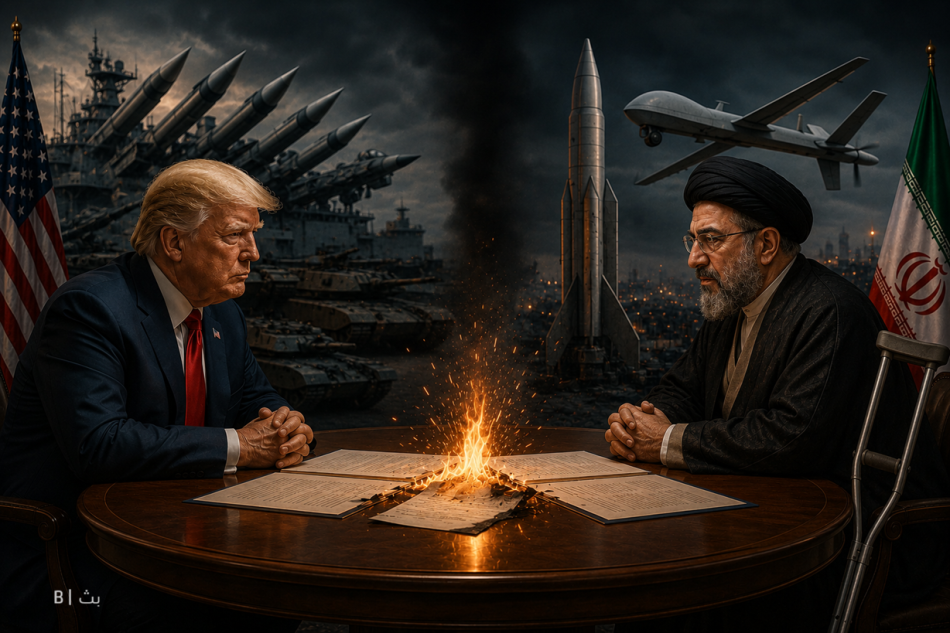
The U.S.–Israeli confrontation with Iran has entered a new phase of escalation, less than 24 hours after renewed exchanges of strikes between Israel and Iran, in a development that threatens to undermine the path of de-escalation and the political talks that had been presented as a possible route toward ending the war.
The spark began on Sunday when Israel struck four sites linked to Hezbollah and Iran’s Islamic Revolutionary Guard Corps (IRGC) in Beirut’s southern suburbs.
Iran responded in the evening with successive waves of missiles toward Israel, beginning with four consecutive launches before the total rose to around eleven missiles overnight, all of which Israel said were intercepted.
In a further escalation, the Israeli military announced on Monday that it had targeted Iran’s “strategic defense systems,” alongside new strikes across various parts of Iran, including targets in Tehran.
Israel stated that the attacks were carried out solely by Israeli forces, while noting that the United States assisted in intercepting some of the Iranian missiles but did not participate directly in the offensive operations.
Meanwhile, Tehran held Washington responsible for the renewed hostilities, arguing that Israel could not have carried out such actions without prior coordination with the United States.
Iranian Foreign Ministry spokesman Esmail Baghaei stated that no one believes Israel would undertake such operations without American cooperation, warning that the latest military developments would affect the ongoing talks with Washington aimed at ending the war.
At the same time, U.S. President Donald Trump reiterated his call for both sides to cease fire immediately, urging restraint and warning against a broader escalation.
BETH Analysis
The events of the past several hours suggest that the ceasefire was not the end of the crisis, but merely a temporary pause within a conflict whose core issues remain unresolved.
What stands out is that Israel expanded its operations from targeting Iran-linked sites in Lebanon to striking targets inside Iran itself, signaling an effort to prevent Tehran from establishing a new deterrence equation linking attacks on its regional network to direct retaliation from Iranian territory.
Iran, on the other hand, appears determined to reinforce a different message: that attacks on its centers of influence in the region will not go unanswered, and that Tehran retains the ability to impose costs on its adversaries despite mounting military and political pressure.
Washington finds itself in a more complex position.
It continues to support Israel militarily and strategically, while simultaneously attempting to prevent the escalation from reaching a point that would eliminate the possibility of a political agreement with Iran.
This creates what appears to be a contradiction:
Israel strikes.
Iran responds.
Washington calls for a ceasefire.
Yet this apparent contradiction may actually be part of crisis management rather than evidence of a lack of coordination.
Where Is This Headed?
Current indicators do not suggest that any of the parties are seeking a full-scale war.
At the same time, none of them appears willing to be seen as backing down.
As a result, the region now faces a highly sensitive phase in which missiles and negotiations are unfolding simultaneously, and military actions are increasingly being used as tools of political pressure.
The question that will shape the coming days remains:
Will yesterday’s spark ignite a larger military confrontation?
Or is the current escalation merely a final effort to improve negotiating positions before a return to the table?
A Fragile Pause in Escalation, Not the End of the Confrontation
Iran announced the end of its operations against Israel following the latest waves of missile launches, while clearly warning that it would respond again if attacks on Lebanon or on interests linked to it continue.
Meanwhile, U.S. President Donald Trump publicly pushed for a ceasefire and a return to negotiations, stressing that “both sides must stop firing.”
BETH Quick Analysis
The developments of the past few hours suggest that:
- Iran sought to deliver a political and military response to the strikes on Beirut’s southern suburbs.
- Israel sought to demonstrate that it would not accept missile attacks without responding.
- Washington moved quickly to prevent the situation from escalating into a broader war.
As a result, it appears that all parties have reached a point where they are effectively saying:
“The message has been delivered.”
But the real question is not:
Have the attacks stopped?
Rather:
Have the reasons behind the attacks disappeared?
So far, the answer is no.
BETH | B
BETH (بث B) – All rights reserved