



Why Does Humanity Need an Enemy?
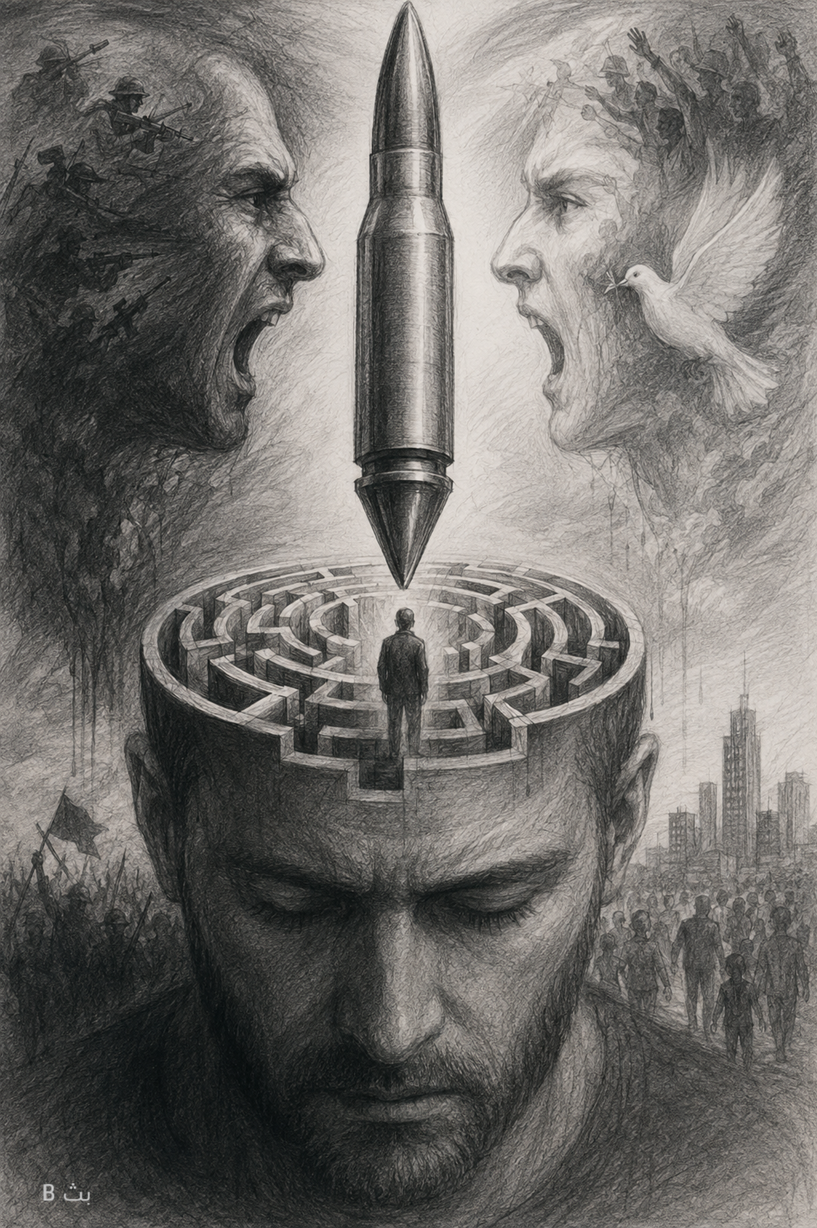
Peace and the Making of an Enemy
Prepared and Analyzed by
Strategic Media Department – BETH Agency
Supervision: Abdullah Al-Omairah
For thousands of years, wars have repeated themselves, alliances have shifted, and names have changed. Yet one question has remained quietly present in the background of human history:
Why does humanity need an enemy?
At first glance, the question seems simple.
But perhaps its significance lies in the fact that it is not really a question seeking a direct answer. Rather, it is a question that demands to be deconstructed.
Does humanity truly need an enemy?
Or does it need something else and simply give it the name "enemy"?
Why Peace?
Peace is not merely the absence of war.
Nor is it a temporary truce between rivals.
At its core, peace is humanity’s ability to direct its energy toward building rather than destroying, and toward the future rather than fear.
Wars may produce military victories.
But peace builds civilizations.
It creates prosperity.
It advances knowledge.
And it gives generations the opportunity to live.
For this reason, peace has never been the opposite of strength.
It is one of its highest expressions.
Why Create an Enemy?
The paradox is that human beings are not born searching for enemies.
A child knows no hostility.
A person immersed in love, creativity, and construction is not searching for an adversary.
And civilizations at the height of their prosperity tend to focus more on what they wish to become than on whom they hate.
So where does the enemy come from?
Is it discovered?
Or invented?
Here begins the real question.
Does Humanity Need an Enemy?
Perhaps humanity does not need an enemy as much as it needs an explanation.
When people struggle to understand fear.
Or explain failure.
Or confront anxiety.
They often seek a framework into which they can place those emotions.
The “enemy” then emerges as a convenient explanation for the world.
Rather than confronting difficult questions, it becomes easier to assign responsibility to someone else.
The question therefore becomes:
Not why enemies exist.
But why we seek comforting explanations.
The Enemy as a Mirror
There is a more unsettling possibility.
What if the enemy is merely a mirror?
People do not always dislike others because they are different.
Sometimes they dislike them because they reveal something they do not wish to see in themselves.
This is why many conflicts are not between opposites.
But between parties that are more alike than they realize.
As if humanity is chasing a part of itself and giving it another name.
Identity and the Enemy
Throughout history, many communities and nations have defined themselves through comparison.
Us and them.
Inside and outside.
Friend and foe.
In this sense, the enemy sometimes becomes less a rival and more a tool of self-definition.
But a deeper question remains:
Can a strong identity be built without a permanent adversary?
Are great nations built on projects?
Or on hostilities?
Media and the Making of an Enemy
The media can expose genuine dangers.
But it can also magnify them.
It can explain events.
Or reduce the world to a struggle between absolute good and absolute evil.
When media loses its balance, the enemy ceases to be a reality that requires understanding and becomes a commodity sold to audiences.
Fear grows.
Thought shrinks.
And anger becomes faster than understanding.
The Real Enemy and the Imagined Enemy
Not every enemy is imaginary.
History is filled with real conflicts.
Competing interests.
Ambitions.
And conspiracies.
But danger begins when every disagreement becomes hostility.
Every crisis becomes a conspiracy.
And every criticism becomes a threat.
At that point, the enemy becomes more of a psychological function than an objective reality.
And the question becomes:
Are we confronting a real enemy?
Or avoiding confrontation with ourselves?
The Most Dangerous Enemy
Perhaps the most dangerous enemy is not the other side.
But the mind that cannot live without an enemy.
A mind that requires a permanent adversary to justify its mistakes.
Explain its failures.
And exempt itself from self-criticism.
Such a mind does not create peace.
Nor progress.
Because it is still searching for others before searching within itself.
What Does Humanity Lose When It Loses Its Enemy?
The question may seem strange.
Yet many individuals, groups, and even nations have grown accustomed to defining themselves through their rivals.
As a result, the disappearance of an enemy can sometimes create an identity crisis.
Some people know who they hate more clearly than they know what they want.
And here lies the paradox:
Perhaps humanity does not need an enemy.
But a project.
A purpose.
A cause.
A goal greater than hatred.
When purpose disappears, the enemy takes its place.
And when hope fades, hostility becomes a daily occupation.
Conclusion
Perhaps the question itself needs to be reconsidered.
The real question is not:
Why does humanity need an enemy?
But rather:
Does it truly need one at all?
Or is the enemy, in many cases, merely a temporary name for something else:
Fear.
Emptiness.
The search for meaning.
Escape from the self.
And the inability to build a project worthy of devotion.
War may need an enemy.
But peace requires a human being who knows what he wants.
Makers of Hostility
Perhaps the more important question is:
Why is it easy to ignite hostility while so difficult to build peace?
Hostility requires only a spark.
Peace requires awareness, patience, trust, and wisdom.
Conflicts can be ignited in moments.
Yet healing them may take years, even generations.
Traditional wisdom has long recognized this reality.
As the saying goes:
“People are enemies of what they do not understand.”
Many hostilities begin with ignorance and misunderstanding rather than genuine danger.
Another proverb reminds us:
“Not everything white is fat, and not everything black is coal.”
Life is far more complex than the quick labels that divide the world into heroes and villains.
And the saying:
“Write in water, but carve in stone.”
Reminds us that some people build lasting hostilities upon passing causes, holding onto them as though they were eternal truths.
Perhaps that is why history contains many who know how to start fires.
But far fewer who know how to extinguish them.
For building bridges is always harder than building barricades.
Note
This report operates within the realms of human psychology, social dynamics, politics, media, and the shaping of perception.
It does not address opposition to evil, injustice, or disobedience to God. Rather, it examines the forms of hostility that human beings create, expand, or feed upon, until they sometimes evolve from a means into an end, and from a reaction into a way of life.
BETH (B Broadcast) – All rights reserved