


I Am the Republic
Prepared and Analyzed by
Strategic Media Department – BETH Agency
Supervised by: Abdullah Al-Omairah
Those who lived through the era of the late Iraqi president Saddam Hussein remember his famous phrase when beginning some of his phone calls:
“I am the Republic.”
It was a sentence that summarized a state of fusion between the ruler and the state, to the point where Iraq and Saddam appeared to be one and the same.
Those who followed his trial while he stood inside the defendant’s cage also remember how he repeatedly said:
“I am the President of the Republic of Iraq and the Commander-in-Chief of the Armed Forces.”
He spoke in the language of authority itself, with the same tone, as though nothing had changed.
In one of the hearings, Judge Raouf Rashid Abdul Rahman responded with a remark that became part of the memory of that era:
“Stop it. You were. Don’t live the role. It’s over. Now you are a defendant. Defend yourself.”
Regardless of whether one agrees or disagrees with Saddam Hussein, that moment carried a profound political lesson.
The authority that once appeared eternal came to an end.
And the state with which he identified himself was no longer able to protect him.
Incidentally,
the “Republic” ultimately shrank into the final “I.”
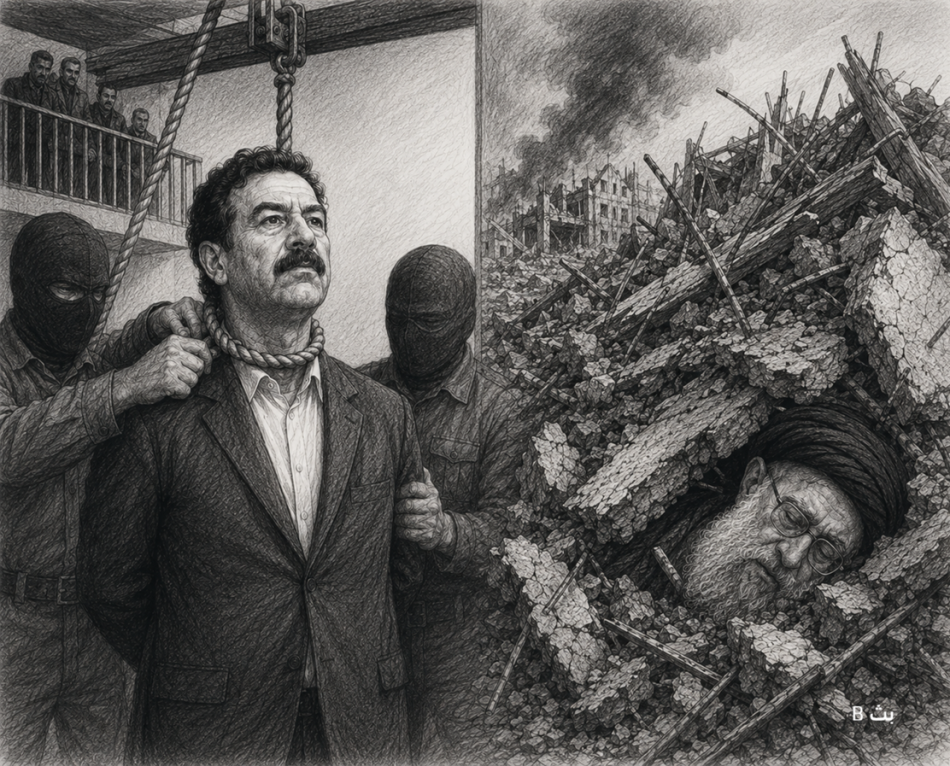
Then-Iraqi Prime Minister Nouri al-Maliki ratified the death sentence, which was carried out at dawn on the first day of Eid al-Adha in 2006.
I still believe that choosing that timing was a grave strategic mistake that will remain a subject of debate for years to come.
Perhaps the coming days will reveal that some of the vendettas that fueled regional turmoil for decades are approaching their end, as figures associated with that period fade away and a long chapter of regional disorder moves closer to its final pages.
Regardless of whether the punishment was justified, and regardless of people’s feelings toward Saddam Hussein, carrying out the execution on the morning of a religious holiday left a deep psychological and political wound for many across the region.
Perhaps that is why some peoples still remember Saddam today, even though he was one of the most controversial Arab rulers and among those least able to read the balance of power around him in his final moments.
But what brought those memories back is not Iraq.
Iraq, despite all it has endured in wars and suffering, will return as history has known it: a land of knowledge and learning, a free nation participating in a new Arab renaissance, and contributing to a more stable and prosperous future for the region.
Rather, it is Iran.
When the News Arrives Late to Its Owner
One of the strangest phenomena in politics is that the world sometimes recognizes the end of an era before its owners do.
That is what happened with Saddam Hussein.
In his final days, the question among his opponents was not:
Will he fall?
But rather:
When will he realize that he has already fallen?
He still spoke as a president.
Addressed the court as a president.
Behaved as a president.
While the state he governed had already slipped from his hands.
Today, part of the Iranian scene appears to be moving in a similar direction.
The official discourse still speaks the language of power.
The Islamic Revolutionary Guard Corps still speaks the language of those who set the terms.
And the Iranian negotiator still behaves as though time is working in his favor.
Yet daily realities suggest that the balance of power is no longer what it once was.
The Problem Is Not the Fall
Regimes do not collapse suddenly.
The real collapse begins when rhetoric becomes detached from reality.
When a leader believes that the tools that built his influence decades ago still function with the same effectiveness.
When he assumes that others fear him to the same degree.
And when he treats major transformations as though they were merely passing clouds.
At that moment begins the most dangerous form of political blindness:
To see the past clearly...
But fail to see the present.
From “I Am the Republic” to “I Am the Revolution”
Here, we are not comparing Iraq and Iran.
Nor are we comparing Saddam Hussein with the clerical regime.
Rather, we are reflecting on a political phenomenon that repeats itself throughout history.
In the first case, there was a ruler who believed that the state still revolved around him.
In the second, there appears to be a regime that still believes the region revolves around it.
In both cases, the same question emerges:
Does reality still support that conviction?
Or have its owners simply not yet heard the news that everyone else already has?
The current scene suggests that some pillars of the Iranian system continue to operate with the mentality of a bygone era.
An era in which networks of influence were expanding.
Regional capitals were unsettled by Iranian messages.
And militias served as effective instruments of regional pressure.
Today, many of those cards have been exhausted, contained, or diminished.
Yet the rhetoric still speaks the language of yesterday.
And therein lies the problem.
Not in the amount of power that remains.
But in the belief that the rules of the game have not changed.
The Final Scene
History does not bring down regimes merely when they become weak.
It does so when they refuse to acknowledge that time itself has changed.
Saddam Hussein’s final problem was not that he lost power.
It was that he continued speaking as though he still possessed it.
Today, as military, political, and economic pressures on Iran continue to intensify, a question worthy of reflection emerges:
Are some leaders in Tehran still living inside the image of the Iran that once was?
Or have they begun to realize that the region they knew twenty years ago no longer exists?
Because the most dangerous moment in politics is not the moment of defeat.
It is the moment when a person continues performing his old role...
After the entire stage has changed.
The scene has been overturned, and the cards that granted Tehran influence for decades no longer hold the same strength. What was once managed through maneuvering and buying time now appears to be approaching a confrontation with a reality whose reckoning has long been postponed.
BETH (B Broadcast) – All rights reserved