



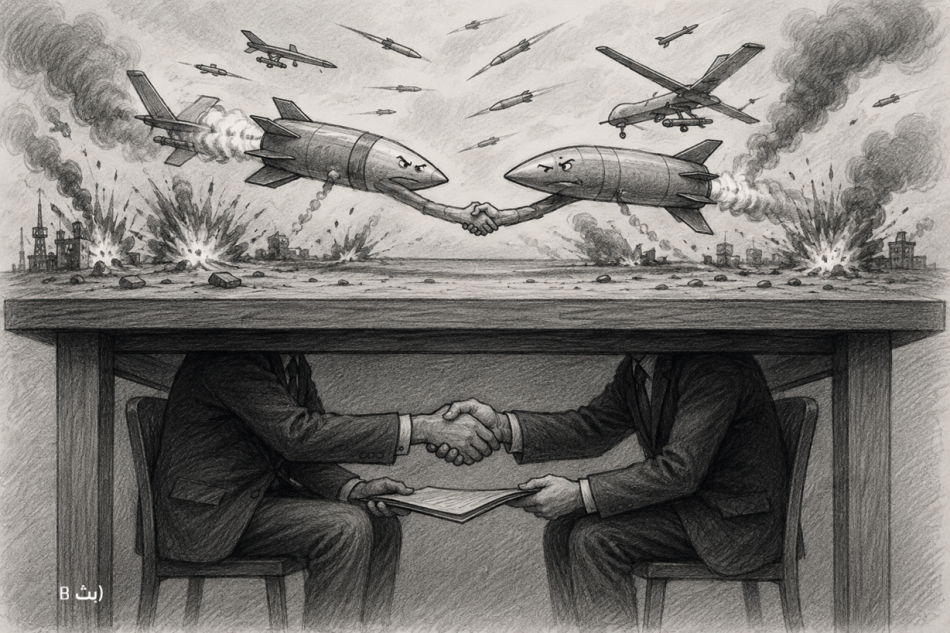
Day 96: Negotiations in a Battlefield
Monitoring & Analysis | BETH Agency
The U.S.–Iran confrontation has entered a more sensitive phase after the conflict expanded from targeting military facilities to threatening maritime routes and Gulf states.
Following U.S. strikes on Iranian coastal radar sites in Qeshm and Gourk, the Islamic Revolutionary Guard Corps (IRGC) responded with a direct threat to completely close the Strait of Hormuz if U.S. operations continue, while claiming to have targeted American bases in Kuwait and Bahrain with ballistic missiles.
Meanwhile, Kuwaiti and Bahraini authorities stated that a civilian airport and civilian facilities were hit, while no U.S. military installations suffered any damage.
In contrast, the U.S. military confirmed that most of the missiles were intercepted and that no casualties or significant damage occurred at American military facilities.
Saudi Arabia Condemns the Escalation
Saudi Arabia condemned the Iranian attacks on Bahrain and Kuwait, stressing that they constitute a violation of sovereignty and a threat to regional and international security.
The Kingdom also reaffirmed its full solidarity with both countries and its support for all measures aimed at preserving their security, stability, and sovereignty.
Overview
- U.S. forces targeted Iranian coastal radar sites in Qeshm and Gourk.
- The IRGC threatened to close the Strait of Hormuz to oil and gas exports.
- Iran claimed it had targeted U.S. “bases” in Kuwait and Bahrain.
- The U.S. military reported that seven ballistic missiles were launched, six of which were intercepted, while the seventh failed to reach its target.
- Bahrain activated air raid sirens after explosions were heard near Manama.
- The escalation comes days after an attack on Kuwait International Airport that resulted in casualties and damage to the facility.
- U.S.–Iran negotiations remain stalled over the nuclear file, frozen Iranian assets, and the issue of unrestricted navigation through the Strait of Hormuz.
- Pakistan has intensified mediation efforts through repeated visits and contacts by Interior Minister Mohsin Naqvi with Iranian officials.
- President Donald Trump has informed mediators that negotiations should not extend beyond 60 days.
BETH Analysis
The current situation suggests that both sides are seeking to increase pressure without sliding into a full-scale war.
Iran understands that actually closing the Strait of Hormuz could trigger a broad U.S. and international response that would be difficult to contain. As a result, the Strait remains, for now, more of a strategic pressure card than an imminent operational decision.
The United States, meanwhile, appears determined to safeguard freedom of navigation and maintain the uninterrupted flow of global energy supplies. At the same time, Washington continues to avoid launching a major strike that could push the region into an open confrontation.
Notably, the missiles launched toward Kuwait and Bahrain did not achieve any significant military impact, suggesting that the political message may have been more important than the military outcome itself.
At the same time, Pakistan’s repeated mediation efforts indicate that negotiation channels remain open despite the rising level of military escalation.
Why Has Washington Not Forced Hormuz Open?
Because the challenge is not military capability.
The U.S. Navy is theoretically capable of securing maritime traffic through force. However, the cost of such a decision extends far beyond military considerations.
Forcing the Strait open could lead to:
- A sharp surge in global energy prices.
- A broader conflict across the Gulf region.
- Attacks on oil facilities and regional ports.
- The involvement of additional regional and international actors.
For this reason, Washington continues to rely on a strategy of gradual pressure while keeping larger military options in reserve.
What Does the Mosaic Picture Suggest?
Three key indicators stand out:
First: Iran continues to bet on endurance and buying time.
Second: Trump seeks a rapid agreement rather than endless negotiations.
Third: Mediators are moving with urgency, suggesting that all parties recognize the risks of reaching a decisive breaking point.
The question is no longer:
Can the United States reopen the Strait of Hormuz?
The question has become:
Can Iran bear the cost of closing it?
In major crises, victory does not belong only to the side capable of starting a fire, but to the side capable of enduring its heat until the very end.
BETH (B Press) – All rights reserved