


Day 95: Faces or Ideas?
Monitoring & Analysis | BETH | B
Ninety-five days into the U.S.–Israeli confrontation with Iran, the region continues to move within a cycle whose end remains difficult to define.
Negotiations continue.
Pressure continues.
Threats continue.
Yet a decisive outcome remains absent.
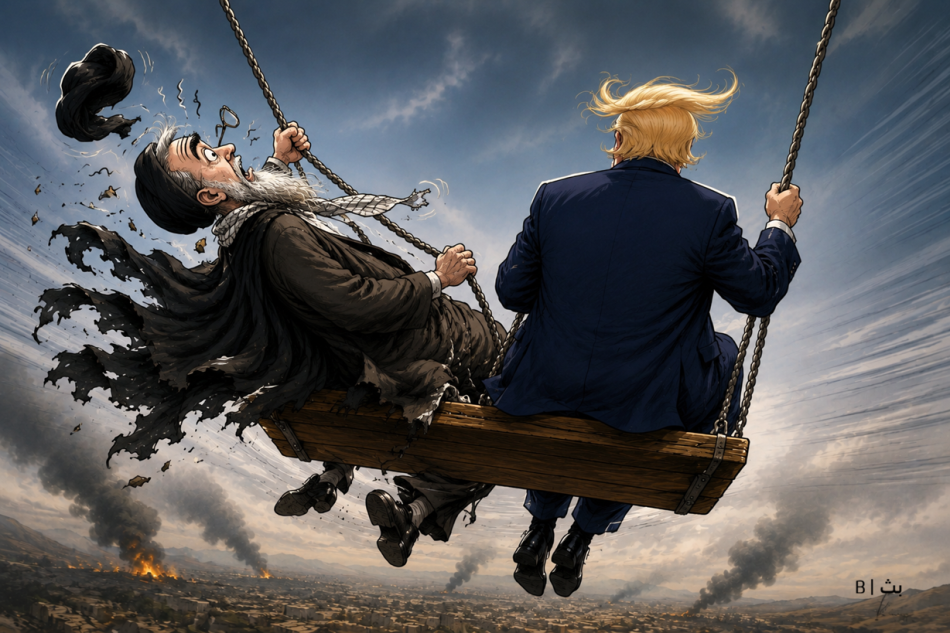
The situation increasingly resembles a political and security swing, moving back and forth between escalation and de-escalation without reaching a final destination.
In the latest development, Pakistan has once again entered the mediation track. Pakistani Interior Minister Mohsin Naqvi met his Iranian counterpart Eskandar Momeni for the second time within 24 hours, in an effort to narrow differences between Tehran and Washington amid renewed attempts to revive an agreement that could ease the ongoing confrontation.
In Lebanon, complexity remains the dominant feature of the landscape.
While the United States has proposed a ceasefire framework, Israel’s security cabinet has not voted on the proposal following Hezbollah’s rejection of it.
Prime Minister Benjamin Netanyahu stated that the agreement was not submitted for approval because Hezbollah continues to oppose it, indicating that any Israeli endorsement remains tied to the group’s position.
Meanwhile, Hezbollah Secretary-General Naim Qassem rejected withdrawal from southern Lebanon, objecting to the proposed arrangement and calling instead for a comprehensive ceasefire and the withdrawal of Israeli forces from Lebanese territory.
In Iraq, efforts continue to reduce the influence of Iran-linked armed factions, alongside regional and international attempts to prevent the conflict from expanding toward Gulf states or critical maritime routes.
BETH Analysis
Every time the parties appear to move closer to an agreement, a new obstacle emerges.
And every time tensions rise, diplomacy returns to the conversation.
As a result, the question is no longer:
What will happen tomorrow?
But rather:
Why has the situation not been resolved yet?
Three major schools of thought have emerged among analysts and observers.
The First View: Inability to Achieve a Decisive Outcome
Supporters of this view argue that the complexity of the regional landscape and the multiplicity of fronts and proxy actors have made a decisive resolution more difficult than initially expected.
However, this interpretation faces a significant challenge.
The military, technological, and economic balance of power does not suggest the existence of a genuine inability to act if a political decision to do so were made.
For this reason, many observers regard this explanation as the least convincing.
The Second View: Managing the Conflict Rather Than Ending It
Another school argues that the American and Israeli objective is not the collapse or dismantling of the Iranian state.
Instead, the goal is to alter Iran’s nuclear and regional behavior at the lowest possible cost.
Under this approach, the priorities become:
- Reducing influence.
- Containing expansion.
- Modifying behavior.
- Preventing the acquisition of capabilities that could threaten regional balance.
All without embarking on a broader conflict that could produce unpredictable consequences in a country of more than 90 million people located at the heart of a highly sensitive region.
In this framework, sanctions, pressure, and targeting regional proxies become more attractive tools than a full-scale war.
The Third View: The Strategy of Long-Term Containment
This interpretation is gaining increasing attention in strategic assessments.
What is unfolding across:
- Lebanon,
- Iraq,
- Syria,
- The Gulf,
- And the nuclear file,
appears to be different fronts within a single long-term confrontation.
The objective is not a rapid knockout blow.
Rather, it is the gradual erosion of Iranian influence, the reduction of its regional tools, and the weakening of its ability to project power and shape events.
Under this view, the conflict is measured not merely by missiles or airstrikes, but by each side’s ability to endure over time.
Individuals or the System?
Perhaps the deeper question is this:
Is the confrontation really about individuals?
Or is it about an entire network of ideas, institutions, and interests?
Political history shows that changing faces does not necessarily mean changing policies.
Major systems derive their strength not only from individuals, but also from the institutions, intellectual structures, and organizational networks built around them.
For this reason, some analysts argue that the core of today’s confrontation is not a specific personality, but the broader project that has evolved over decades and the ability of its key institutions to adapt, survive, or transform.
New rhetoric may appear calmer or more pragmatic.
Yet rhetoric alone does not determine outcomes.
The real test lies in actions on the ground, regional relationships, and the role played by influential institutions in shaping decision-making.
The Bigger Question
After ninety-five days, the question is no longer:
Will an agreement be signed?
Or:
Will another strike take place?
Instead, the question has become:
Is the objective to change the regime?
Or:
To change the regime’s behavior?
The distinction between these two questions may explain much of the patience, hesitation, and strategic ambiguity that continue to define the conflict today.
Reflection
Perhaps the struggle unfolding today is not simply against a government, an individual, or an organization.
It may instead be a confrontation with a broader network of ideas, interests, and instruments accumulated over decades.
And therefore, the question that may ultimately shape the future of the Middle East is not:
Who will remain?
But:
What will actually change if the faces remain the same—or if they are replaced?
BETH (B Press) – All rights reserved