



The Middle East and the Night of Ideologies
Monitoring & Analysis | BETH | B
Many political articles discuss the outcomes of conflicts.
Far fewer stop to examine the ideas that create those conflicts in the first place.
In his article “The Night of Ideologies in the Middle East,” Lebanese writer and political analyst Nabih Al-Burji embarks on an intellectual journey through history, religion, politics, and geography, attempting to explain the chronic instability that has long characterized the region.
Yet the true value of the article lies not in the sheer number of references and historical figures it invokes, but in the question that stands behind them all:
Is the problem rooted in ideas themselves?
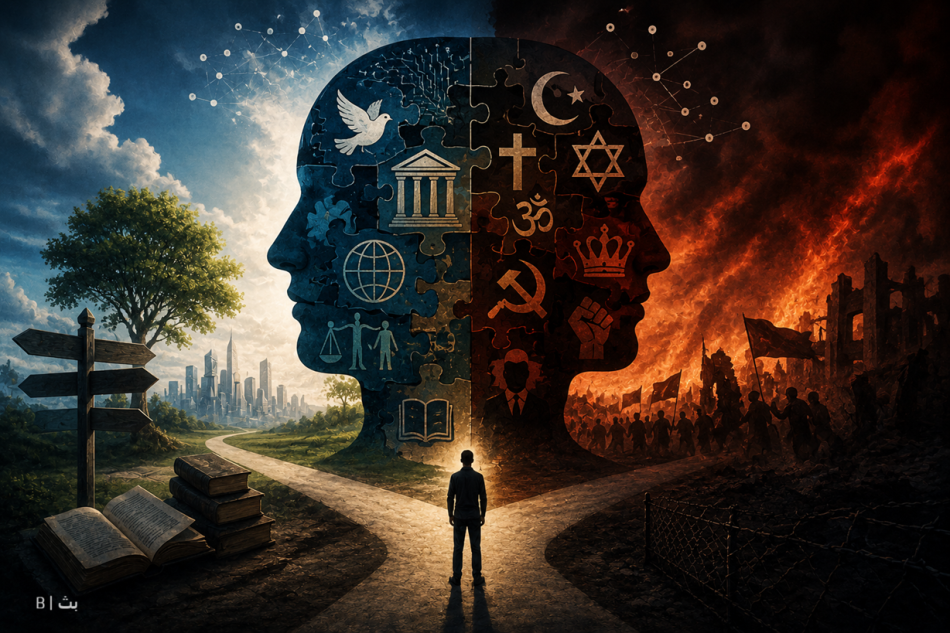
Or does it emerge at the moment when ideas transform into closed ideologies that view the world from a single angle and treat difference as a threat rather than an opportunity for understanding?
The author explores the relationship between the Middle East and ideological conflict, drawing on numerous historical and intellectual references that connect religion, politics, ideology, geography, and international power struggles.
But this question also opens a broader field of reflection:
Is the region’s uniqueness rooted in the ideas themselves, or in the deep overlap between religion, identity, history, and politics? Or is ideological conflict a universal human phenomenon that has appeared in many civilizations and societies throughout history, albeit in different forms?
From this perspective, BETH presents this material, leaving readers free to reflect upon and evaluate the ideas and conclusions offered by the author.
BETH Analysis
What Is Ideology?
Ideology is a system of ideas and beliefs through which people interpret the world, understand others, and define their relationship with authority, society, and history.
In itself, ideology is neither inherently good nor inherently bad.
Virtually every nation, movement, and state is built upon a set of ideas, values, and visions.
The danger begins when an idea turns into an absolute truth that cannot be questioned, revised, or challenged.
Ancient Ideologies
History has witnessed many forms of ideology, including:
- Religious ideologies.
- Imperial ideologies.
- Nationalist ideologies.
- Ethnic ideologies.
These emerged across different regions of the world, from the Middle East to Europe and Asia.
Modern Ideologies
The twentieth century saw the rise of more organized and influential ideological systems, including:
- Communism.
- Nazism.
- Fascism.
- Modern imperialism.
- Radical nationalism.
- Certain forms of radical liberalism.
- Various contemporary political and economic ideologies.
Most of these ideologies originated in Europe or the industrialized West before spreading across the globe.
Why Is Religious Ideology Concentrated in the Middle East?
Because the Middle East is more than a geographical region.
It is the birthplace of the major monotheistic religions.
It also represents a unique intersection of:
- Religion.
- Identity.
- History.
- Authority.
- Collective memory.
As a result, intellectual and ideological disagreements in the region often become more sensitive than in other parts of the world.
Conflicts are not always perceived merely as political disagreements; they are often viewed as disputes involving identity, existence, and meaning itself.
This raises an additional question:
Is this linked to the fact that early human settlements and civilizations were concentrated in this region?
To a large extent, yes.
The Middle East was among the earliest centers of human settlement and civilization. Many of humanity’s earliest questions about creation, existence, authority, ethics, and the relationship between humanity and the universe emerged from this region.
However, this factor alone does not fully explain the phenomenon.
Other great civilizations also arose in China, India, Mesoamerica, and elsewhere.
What distinguishes the Middle East is the combination of two factors:
- Its role as the birthplace of the major monotheistic religions.
- The continued influence of those religions on politics, identity, and public life up to the present day.
For this reason, religious ideas remain more prominent in public discourse than in many regions that have gradually moved toward a greater separation between religion and politics or have redefined the relationship between them.
Why Are Other Ideologies Distributed Across Different Regions?
Because ideologies generally emerge from the environments that produce them.
Communism emerged from the conditions of industrialization and class struggle.
Fascism and Nazism arose from specific European circumstances.
Modern imperialism was closely linked to periods of colonial expansion.
In other words, geography is not merely the stage upon which ideologies act.
It is often one of the forces that gives birth to them.
Are Ideologies Opposed to One Another?
Yes—and no.
They often compete in their slogans, goals, and methods.
Yet they share one important characteristic:
When an ideology becomes a closed doctrine, it tends to become more concerned with defending itself than with searching for truth.
That is where the danger begins.
History shows that many major conflicts did not arise because of a shortage of ideas, but because of absolute certainty in those ideas.
Conclusion
Perhaps the Middle East’s challenge does not lie in having too many religions or too many ideas.
Rather, it lies in the difficulty many forces face in distinguishing between:
- Faith and ideology.
- Identity and fanaticism.
- Conviction and truth.
An idea that remains open to discussion can become a source of progress.
But when it turns into a closed prison of thought, it can become a source of endless conflict.
BETH (B Press) – All rights reserved