


SAR 13.3 Billion to Develop Makkah
Makkah | B | بث
31 May 2026
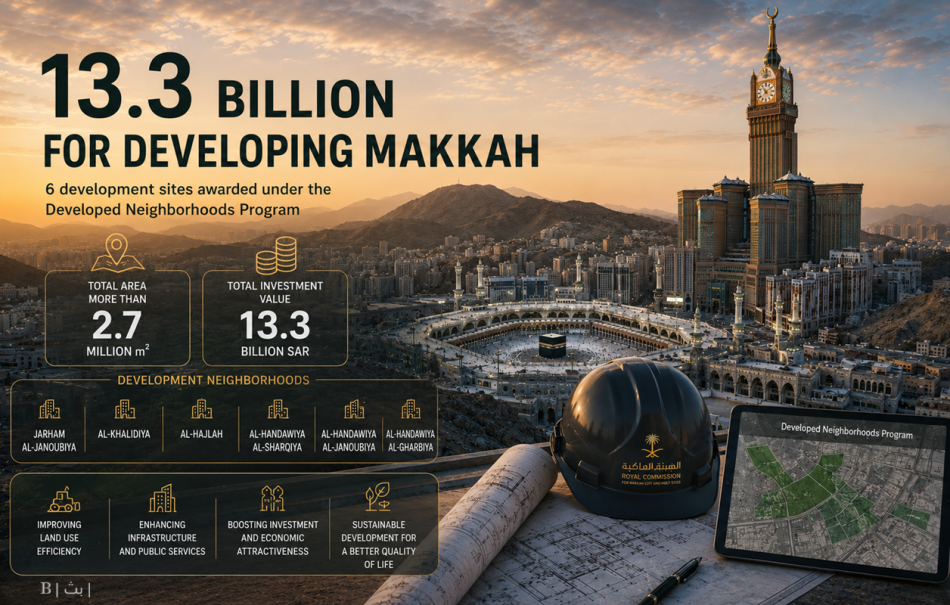
The Royal Commission for Makkah City and Holy Sites announced the award of six development sites under the Developed Neighborhoods Program, covering a total area exceeding 2.7 million square meters, with an investment value of SAR 13.3 billion.
The initiative aims to advance the urban environment, strengthen economic activity and quality of life, and support sustainable development in the Holy Capital.
The development sites include the neighborhoods of Jarham South, Al-Khalidiyah, Al-Hajlah, East Al-Handawiyah, South Al-Handawiyah, and West Al-Handawiyah, through alliances involving real estate developers, investment companies, and investment funds, reflecting an integrated model between regulatory and implementation entities to deliver urban projects with sustainable economic and developmental impact.
The Commission explained that the projects form part of the Developed Neighborhoods Program, which focuses on redeveloping priority areas through improving land-use efficiency, upgrading infrastructure and public services, addressing urban challenges, and enhancing Makkah’s investment and development attractiveness.
It also confirmed that implementation will follow integrated regulatory and technical procedures, including qualification, awarding processes, approval of master plans, technical studies, and execution phases, ensuring the highest planning and engineering standards while achieving balanced urban development and preserving the city’s urban and social fabric.
B Analysis
What stands out in this announcement is not only the scale of investment.
It is the nature of the transformation itself.
Urban development is no longer centered on conventional expansion.
Instead, it focuses on reshaping the city from within through greater efficiency, improved quality of life, and more sustainable use of land and infrastructure.
The SAR 13.3 billion figure reflects Makkah’s transition into a deeper stage of urban development; one that is not focused merely on expanding space, but on improving housing experience, services, and urban connectivity in a way that aligns with the city’s status and future growth requirements.
The participation of investment alliances and funds also signals a model built on partnership between planning, execution, and investment, expanding economic impact and strengthening long-term sustainability.
In a city that welcomes millions of visitors every year, the quality of planning becomes part of the quality of the experience itself.