


Something Is Moving Beneath Everyone’s Feet..!
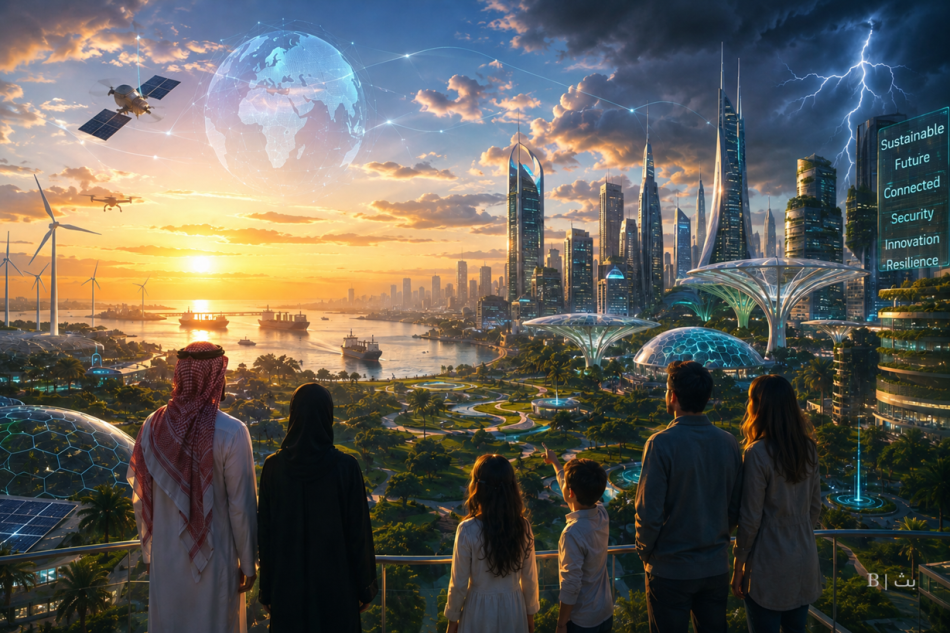
The Age of Abundance .. or the Age of Self-Sufficiency?
Prepared and Analyzed by the Strategic Media Department – B News Agency | B
Supervised by: Abdullah Al-Omairah
Introduction
For decades, the modern world was built upon an idea that seemed almost unquestionable:
That nations need one another.
Trade crosses borders.
Energy flows across continents.
Industries depend on supply chains stretching thousands of kilometers.
Markets are interconnected in ways that make the prosperity of one party linked to the prosperity of others.
As a result, a widespread belief emerged that shared interests reduce conflicts and that mutual dependence helps sustain stability.
But a new question has quietly begun moving beneath everyone’s feet:
What happens when nations and corporations need each other less?
The World We Know
Just twenty years ago, the picture appeared clearer:
- Energy came from the Gulf.
- Industry came from the West.
- Labor came from Asia.
- Technology came from America.
- Markets were distributed among all.
Mutual dependence was part of the stability equation.
Each side possessed something the other needed.
And each side understood that confrontation could jeopardize a vast network of shared interests.
But the world has begun to change.
The New Abundance
Today, we are witnessing transformations that would have been difficult to imagine only a few years ago.
Renewable energy is expanding.
Artificial intelligence is reducing reliance on many traditional jobs.
Robots are entering factories, ports, and service centers.
3D printing is bringing production closer to consumers.
Food security has become a national priority.
Technological security has become a national priority.
Pharmaceutical security has become a national priority.
Some countries have even begun discussing digital sovereignty in much the same way they once discussed military sovereignty.
And here emerges the central question:
Is all of this leading us toward a safer world?
Or toward a world that needs cooperation less?
When Dependence Declines
Throughout history, relations between nations have not been built on goodwill alone.
Nor on principles alone.
They have been built on necessity.
The need for food.
Energy.
Markets.
Technology.
And security.
These needs compelled nations to engage with one another, even when they disagreed.
But what if that necessity begins to fade?
What if countries become capable of producing most of what they need?
What if major corporations can operate factories with robots, manage operations through artificial intelligence, and secure their data within their own digital borders?
At that point, the question may no longer be:
How do we cooperate?
But rather:
Why do we cooperate at all?
And that is where the more profound transformation begins.
Does Abundance Create Peace?
The answer may seem obvious:
The more abundance there is, the less conflict there should be.
History, however, offers a more complicated answer.
Many conflicts were not born solely from scarcity.
They emerged from competition.
Ambition.
Influence.
And fear of the future.
For this reason, declining interdependence may produce outcomes opposite to what some expect.
If nations no longer rely on one another economically as they once did, the nature of international relations itself may change.
Influence, technology, data, and cybersecurity could become arenas of competition even more intense than many traditional resources.
The Deeper Shift
Perhaps we are not witnessing the end of globalization.
But rather the beginning of a new phase of it.
A phase that might be called:
The Age of Connected Independence
An era in which nations seek to:
- Manufacture what they need.
- Produce their own food.
- Secure their energy.
- Protect their data.
- Develop their technologies.
Yet without isolating themselves from the world.
The goal is no longer complete dependence.
Nor complete separation.
But reducing vulnerabilities while preserving networks of shared interests.
It is a new balance between independence and integration.
Saudi Arabia and a Different Path
Within this global transformation, Saudi Arabia offers a model worth examining.
The Kingdom is not merely building a post-oil economy.
It is building comprehensive national capabilities across multiple sectors:
- Energy.
- Mining.
- Technology.
- Artificial intelligence.
- Industry.
- Logistics.
- Food security.
- Human development.
What stands out is that this effort is not based on separating from the world.
Rather, it is based on strengthening domestic capabilities while simultaneously expanding global engagement.
Saudi Arabia does not appear to be preparing for a closed world.
It appears to be preparing for a more complex and competitive one.
A world that requires nations to be strong internally while remaining connected externally.
Implications
Some may believe that complete self-sufficiency represents the ultimate form of power.
History suggests otherwise.
Countries that isolate themselves for extended periods may become less vulnerable to external risks.
But they often become less influential as well.
The future may therefore belong not simply to those who achieve self-sufficiency.
But to those capable of combining:
- Internal strength.
- Intelligent openness.
The world does not reward isolation.
Nor does it show mercy to those entirely dependent on others.
Recommendation
If the twentieth century rewarded those who possessed resources,
And recent decades rewarded those who possessed technology,
Then the coming decades may reward those who master a more difficult equation:
The ability to achieve self-sufficiency without isolation.
It is not enough for a nation to produce its own food.
Secure its energy.
Or develop its technology.
It must also preserve its position within global networks of cooperation and mutual interest.
Because future influence may not be measured solely by what nations own.
But by what makes others eager to work with them.
The Final Scene
A century ago, nations competed for territory.
Then they competed for oil.
Then for markets.
Then for data.
The next question may be:
Who can thrive with the least dependence on others?
But perhaps the more important question is:
Who can become strong enough to stand independently... yet wise enough to keep cooperating?
The ability to stand independently creates strength.
The ability to cooperate creates continuity.
Perhaps the world is not moving toward an age of complete self-sufficiency.
But toward a new era in which national power is measured by the ability to balance self-reliance and integration.
That may determine the shape of the coming world.
And it may determine the place of nations that do not merely prepare for the future...
But understand its direction before it arrives.
BETH (B | بث) – All rights reserved