



Post-Hegemony
Is the World Changing While Everyone Is Focused on Wars?
Prepared and Analyzed by | Strategic Media Department – B | B
Supervised by: Abdullah Al-Omairah
The most important question in the world today is no longer:
Who is the strongest?
But rather:
Is the strongest still capable of imposing what it wants?
This is the line that separates power from hegemony.
Power means possessing the tools.
Hegemony means possessing the ability to turn those tools into rules that others follow.
For decades, the world appeared to move within a system led predominantly by a single power.
Yet recent years have revealed that this system no longer functions with the same ease.
What Is Hegemony?
Hegemony is not merely a tank.
Nor merely a fleet.
Nor merely a strong currency.
Hegemony is the ability to define the rules of the game:
Who has the right to wage war?
Who has the right to impose sanctions?
Who defines legitimacy?
Who controls technology?
Who influences money, energy, and strategic routes?
And who can persuade—or compel—others to act according to its terms?
A state may therefore be powerful without being hegemonic.
And it may be hegemonic in one field while weaker in another.
Was There Really Hegemony?
Following the end of the Cold War, the United States experienced what might be described as the “American Moment.”
It was the leading military power.
The largest economic power.
The most influential media power.
And the most influential actor within international institutions.
Yet that hegemony was never absolute.
China was rising quietly.
Russia was waiting for an opportunity to return.
Europe retained its economic weight.
The Gulf possessed energy—one of the most important sources of power and stability in the modern world.
Meanwhile, Asia continued to command markets, demand, and growth.
In other words, hegemony existed, but it was never destined to be permanent.
What Has Changed?
The very rules of power have changed.
Power is no longer measured solely by armies.
It is measured by data, artificial intelligence, energy, supply chains, ports, currencies, technology companies, and the ability to manage stability.
The world no longer waits for a decision from a single capital.
And wars alone are no longer sufficient to determine outcomes.
A major power may be able to strike.
But can it build what comes after the strike?
It may impose sanctions.
But can it prevent others from seeking alternatives?
It may lead a war.
But can it create a lasting peace?
This is where traditional hegemony began to lose part of its appeal.
The Age of Power Has Not Ended
It would be incorrect to claim that major powers have disappeared.
Power still exists.
Armies still matter.
Economics still shapes many decisions.
What is changing is that power alone is no longer enough.
Perhaps the age of hegemony has not ended completely.
But the age of easy hegemony has.
The world is no longer the domain of a single actor.
It has become a complex network of interests, energy, technology, markets, alliances, strategic routes, and emerging players.
The Gulf at the Heart of the Transformation
Here, the Gulf emerges not merely as an oil-producing region, but as a center essential to the continuity of global life.
Energy flows through it.
Investments move through it.
Strategic routes are influenced by what happens within it.
And global stability cannot ignore it.
The Gulf is therefore no longer a peripheral actor in the geography of power.
It has become part of the core equation.
Saudi Arabia: A Different Model
Saudi Arabia represents a distinct model within this transformation.
It does not appear to be a power seeking noise.
It appears to be a power seeking influence.
And the difference is significant.
Noise fills headlines.
Influence changes reality.
But what makes Saudi Arabia different?
The answer is not merely the size of its economy.
Nor its geographic location.
Nor even its energy resources.
Rather, it lies in the nature of the project itself.
While the rise of many major powers throughout history was associated with expanding influence, protecting interests, and widening spheres of impact, the modern Saudi experience rests on a different equation:
- Building people.
- Strengthening stability.
- Diversifying the economy.
- Advancing knowledge and technology.
- Transforming power into a tool for development rather than an end in itself.
Saudi Arabia also differs from many countries in the region in that it does not build influence through crises, but through stability.
Not by exporting conflict, but by reducing it.
Not by exhausting resources, but by investing them in long-term projects aimed at improving quality of life and shaping the future.
What is particularly noteworthy is that Saudi Arabia’s success is not merely about possessing resources.
It is about transforming those resources into plans, projects, and institutions operating according to long-term objectives.
Resources alone do not create success.
Success requires vision, management, and stability capable of turning potential into tangible results.
For this reason, Saudi Arabia’s rise does not appear tied to a temporary event or fleeting circumstance.
Rather, it is the result of a gradual process built upon accumulation, development, investment in people, and adaptation to global transformations.
This experience also rests upon elements that are difficult to overlook in any development project:
- Minds that plan.
- Institutions that execute.
- Financial capabilities that support.
- A stable environment that protects achievement.
- Investment-friendly regulations.
- Security that gives individuals and businesses confidence in the future.
Development does not flourish amid chaos.
Innovation does not grow in unstable environments.
And civilizations do not advance unless societies feel secure and confident about the future.
This is where the real difference lies.
For this reason, Saudi Arabia may not represent a model of a power seeking hegemony.
Rather, it represents a model of a power seeking influence, stability, and the creation of opportunity.
Power attracts attention.
Stability attracts investment.
Achievement creates real influence.
From Hegemony to Partnership
The new world asks more than:
Who controls?
It asks:
Who can preserve stability?
Who can ensure the flow of energy?
Who can protect supply chains?
Who can build partnerships that do not rely solely on coercion?
This is where the meaning of influence begins to change.
In the past, influence was measured by the ability to impose one’s will.
Today, it is also measured by the ability to build trust.
This may be one of the most important transformations of our era.
The Deeper Transformation
What we are witnessing today is not merely the decline of one power and the rise of another.
It is a deeper transformation in the meaning of global leadership itself.
Traditional hegemony asked:
How do I make others move according to my will?
The emerging era asks:
How do I make others see their interest in moving with me?
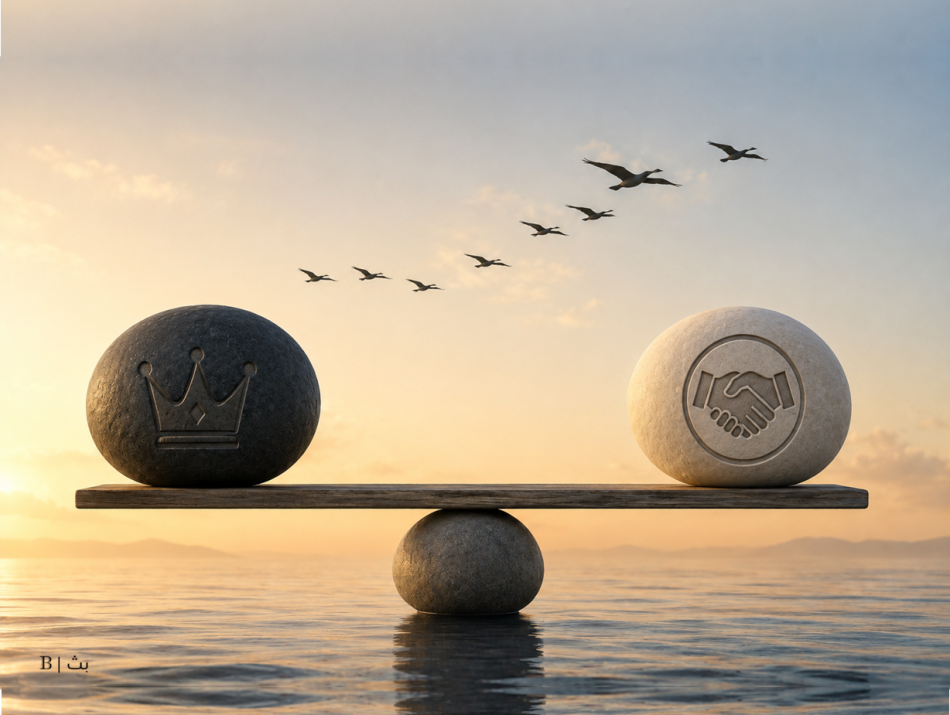
This is the difference between control and partnership.
Control produces fear.
Partnership produces continuity.
Control may succeed for a moment.
Stability requires acceptance, trust, and mutual interests.
Final Scene
The world may not yet have fully entered the age beyond hegemony.
But it has certainly left behind the era of easy hegemony.
Power still matters.
Yet power alone is no longer sufficient.
The world is no longer searching only for those who possess the largest armies.
It is searching for those who possess the clearest vision for managing complexity.
History may remember those who dominated.
But the future will likely reward those who made the world more stable.
BETH (بث B) – All rights reserved