



The Organized Farewell
How Do Pilgrims Depart Without Bringing Movement to a Halt?
Makkah | B |بث
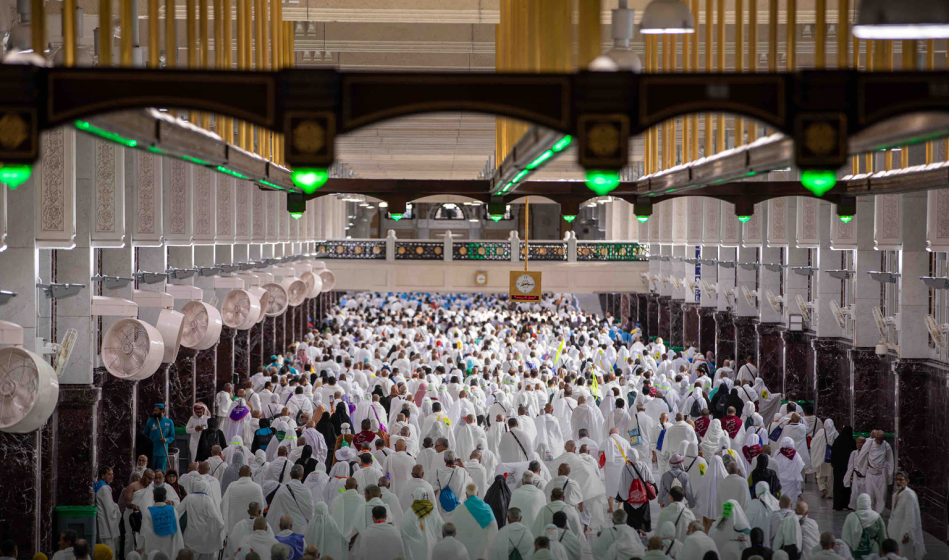
Pilgrims flocked to the Grand Mosque today to perform the Farewell Tawaf, marking the conclusion of their Hajj rituals after being blessed with the completion of the fifth pillar of Islam, within an integrated operational system that ensured smooth movement throughout the Grand Mosque, its courtyards, and surrounding pathways.
The movement of pilgrims entering and leaving the mosque, as well as performing the tawaf, witnessed a high level of organization thanks to approved crowd-management plans, carefully designed movement routes, continuous monitoring of crowd densities, and the provision of healthcare, emergency, and support services.
The Farewell Tawaf is the final rite of Hajj before leaving Makkah. Many pilgrims have already begun returning to their home countries after completing their pilgrimage in an atmosphere marked by security, tranquility, and peace of mind.
B Analysis
When many people look at the Farewell Tawaf, they see the final spiritual moment before pilgrims leave Makkah.
Specialists, however, see another scene that is no less significant.
At this stage begins one of the most complex mass-departure operations in the world.
The challenge is not limited to managing the presence of 1.7 million pilgrims within the holy sites.
It also extends to managing their gradual departure without disrupting movement, services, or transportation networks.
From Arrival to Departure
Attention is often focused on the arrival of pilgrims at the holy sites.
Yet the success of the Hajj season is not complete unless its final phase succeeds as well.
The equation is not only about transporting pilgrims to Arafat, Muzdalifah, and Mina.
It is also about returning them to Makkah and then guiding them to airports, land crossings, and seaports according to precise schedules and organized routes.
For this reason, the Farewell Tawaf stage represents a final test of the entire operational system.
Crowds Moving in Reverse
During the days of Hajj, efforts are concentrated on managing the flow of crowds toward the holy sites.
Once the rituals are completed, the challenge shifts to managing a massive movement in the opposite direction.
This is where the importance of:
- Advance planning.
- Crowd-density management.
- Transportation coordination.
- Departure scheduling.
- Continuity of services until the last pilgrim leaves.
becomes fully evident.
Final Scene
For the pilgrim, the Farewell Tawaf may represent a final spiritual moment before returning home.
Yet behind that moment stands a vast operational system ensuring that millions of footsteps move safely and smoothly until the very last stage of the journey.
For this reason, the success of Hajj does not end with the completion of the rituals.
It is completed when the last pilgrim departs in safety, comfort, and peace.
After Hajj
After completing the Hajj rituals, large numbers of pilgrims travel to Al-Masjid an-Nabawi to pray in the Prophet’s Mosque and convey their greetings to Prophet Muhammad ﷺ and his two companions, Abu Bakr Al-Siddiq and Umar ibn Al-Khattab, taking advantage of their presence in the Kingdom.
Visiting Madinah is an independent spiritual journey and is not part of the rituals or obligations of Hajj, which are confined to the holy sites in and around Makkah.
At the same time, authorities in Madinah continue implementing operational plans to receive visitors and provide services, while large numbers of pilgrims depart the Kingdom through air, land, and sea ports under coordinated transportation and departure plans.
Many pilgrims visit Madinah before performing Hajj, while others choose to visit after completing the pilgrimage, creating a spiritual journey that combines both Makkah and Madinah.
Related Topics
- The Hajj Equation
- Saudi Arabia Monitors the Hajj Environment Using Satellites and Artificial Intelligence
- Hajj Without Outbreaks
BETH (بث B) – All rights reserved