



The U.S. Secretary of War Proposes a New Equation for Alliances
Who Protects Whom?
Coverage and Analysis | B | بث
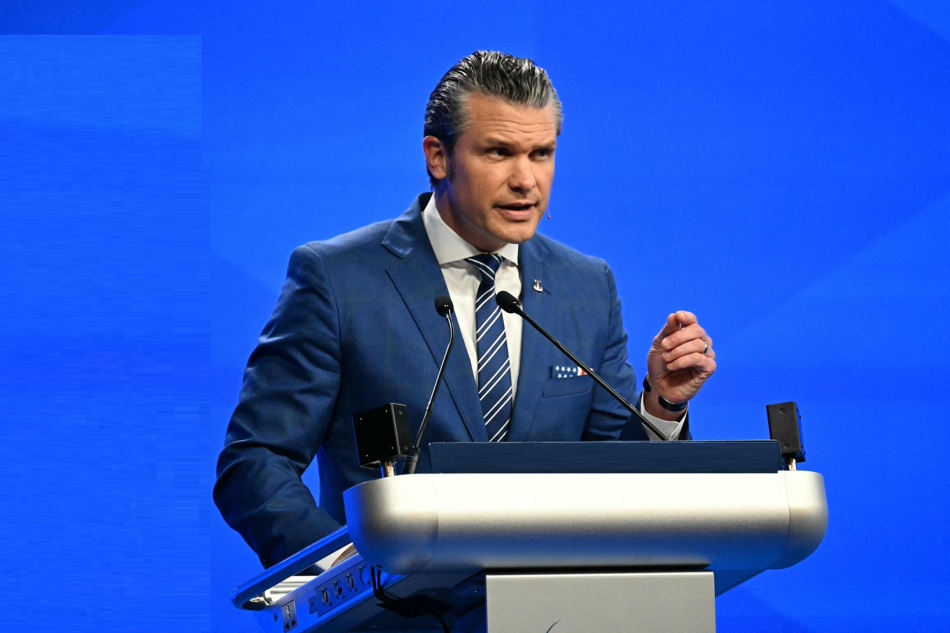
U.S. Secretary of War Pete Hegseth delivered a noteworthy message during his participation in the Shangri-La Security Dialogue in Singapore, stating that the United States wants “strong allies,” not allies that Washington is expected to defend entirely on its own.
The statement comes at a time when the international system is undergoing rapid transformation, from the war in Ukraine and tensions with Iran to the strategic competition with China in Asia.
It reflects a new American approach that calls on allies to assume greater responsibility for their own security and to play a broader role in maintaining regional and international stability.
Overview
Hegseth emphasized that the United States is not seeking allies who rely entirely on the American security umbrella, but rather partners who possess both the capability and the willingness to contribute to their own defense and to the stability of their regions.
He explained that Washington remains committed to its international alliances, but is looking for a more balanced distribution of security responsibilities and burdens, in line with the growing challenges facing the United States across multiple regions of the world.
These remarks are widely viewed as an extension of a trend that has been growing across successive U.S. administrations: encouraging allies to strengthen their defense capabilities and reduce direct dependence on American military forces.
B Analysis
At first glance, the statement appears purely military in nature.
Yet behind it lies a larger question:
Has the concept of an ally changed in the American strategic mindset?
For decades, American influence was built upon a vast network of alliances based on a simple equation:
America provided protection.
Its allies provided political and economic partnership.
But the world has changed.
The United States now finds itself facing simultaneous challenges that include:
- Russia in Europe.
- China in Asia.
- Crises across the Middle East.
- Domestic economic and financial pressures.
Against this backdrop, Washington appears to be reassessing how responsibilities should be distributed within the international alliance system.
This does not appear to be a discussion about abandoning allies.
Rather, it is about redefining relationships with them.
The implicit message is not:
“Defend yourselves alone.”
It is closer to:
“Become stronger, so that we can be stronger together.”
The Gulf and the New Transformation
In this context, the statement carries particular significance for the Middle East.
The Gulf states today are not what they were decades ago.
They now possess:
- Advanced military capabilities.
- Global economic influence.
- Expanding political roles.
- Broad international partnerships.
As a result, the concept of the “strong ally” is no longer theoretical.
It has become a reality shaped by ongoing transformations in the region and around the world.
Yet this shift raises another important question:
Could the new American doctrine trigger a new arms race among allies?
For decades, Washington preferred to maintain military and technological superiority in its own hands, while allies relied—at varying levels—on the American security umbrella and U.S.-supplied defense systems.
Today, however, it is calling for stronger allies that are more capable of defending themselves.
This raises a challenge:
Does this mean encouraging allies to develop their own defense industries and military capabilities?
Or does it simply mean increasing defense spending within the Western security framework while continuing to depend on American technology and weapon systems?
So far, Washington does not appear to be seeking the creation of new military competitors.
Rather, it appears to be seeking partners who can shoulder a greater share of the burden.
History shows, however, that every period marked by expanding military capabilities among states tends to open the door to technological, industrial, and defense competition, while encouraging some countries to pursue greater strategic independence.
One possible unintended consequence of this new doctrine may therefore be the accelerated growth of defense industries among allies, particularly in emerging nations seeking a higher degree of strategic self-reliance.
The question that remains is:
Does Washington want strong allies under its umbrella?
Or is the world gradually moving toward strong allies with broader options and greater independence?
In any case, some Gulf states anticipated this American approach years ago in terms of developing self-reliance and strengthening security partnerships.
They invested in military, security, and technological capabilities, expanded domestic defense industries, and diversified strategic partnerships, making them better positioned to contribute to regional stability and protect their national interests.
As a result, the relationship with the United States, particularly in the Gulf, has evolved beyond the traditional concept of protection alone and toward higher levels of partnership, integration, and shared responsibility.
From this perspective, Hegseth’s statement may not represent the announcement of a new policy as much as it reflects a broader trend that Washington seeks to extend across its alliances worldwide, in an increasingly complex and multipolar world.
Special Reading
At first glance, the U.S. Secretary of War’s remarks may appear to be nothing more than a call for allies to assume greater responsibilities.
A deeper reading suggests something much larger.
The statement appears less an expression of the arrogance of power than a reflection of the fatigue of power.
The United States remains the most powerful military force in the world.
Yet it faces a more complex environment than at any previous time.
- Russia in Europe.
- China in Asia.
- Prolonged crises across the Middle East.
- Domestic economic and political challenges.
Against this backdrop, Washington does not appear to be discussing withdrawal from its global role.
Rather, it is discussing the redistribution of burdens within its alliance structure.
Nor does the statement provide evidence of military incapacity in dealing with Iran.
The United States remains capable of using force whenever it chooses.
However, the experience of recent months has revived a more difficult question:
Is military power alone sufficient to produce the desired political outcome?
Here lies the real dilemma.
The challenge is no longer the ability to wage war.
It is the ability to build what comes after war.
For that reason, the statement may not represent preparation for withdrawal as much as preparation for a new phase based on:
Shared responsibility instead of exclusive dependence on American power.
Perhaps this is why Washington no longer appears to be seeking allies who merely need protection.
Instead, it appears to be seeking allies capable of contributing to stability and safeguarding shared interests.
Viewed from this angle, the statement may signal a broader transformation in American strategic thinking—not because of Iran alone, but because the world has become too complex to be managed through traditional methods alone.
Final Scene
Perhaps the most important aspect of what the U.S. Secretary of War said is not his desire for stronger allies.
Rather, it is what the statement reveals about a deeper transformation within American strategic thinking.
The question increasingly being asked is no longer:
Who protects the allies?
But rather:
How can alliances be built so that everyone becomes stronger?
In a world growing more complex and increasingly defined by multiple centers of power, the strongest ally may not be the one waiting for protection.
It may be the one capable of helping provide it.
Perhaps Washington does not view some of its strong allies as a burden, but rather as an addition to strength and stability.
In this context, Saudi Arabia appears to be a distinct example; a country that possesses significant political, economic, and strategic weight, as well as stability, while at the same time maintaining a historic partnership with the United States — and with other countries — based on shared interests and mutual respect.
Mature relations between nations are not measured solely by the degree of agreement between them, but also by their ability to disagree at times while preserving trust and partnership.
A strong ally is not one who always agrees, but one who possesses the ability to provide support, offer advice, and express its views when circumstances require.
Perhaps this is why mature partnerships become more valuable; because they are built on trust and mutual respect, rather than dependency or necessity.
From this perspective, a strong ally does not add a burden to an alliance; rather, it adds capability, influence, and vision.
BETH (بث B) – All rights reserved