


Day 87: Display of Power.. and the Failure to Achieve Decisive Victory
Follow-up & Analysis | B | بث
Despite the continuation of the diplomatic track between Washington and Tehran, military escalation has once again imposed itself forcefully after the U.S. military shot down four Iranian drones and launched strikes on a base in southern Iran, while Tehran responded by targeting an American base, in the most dangerous confrontation since the ceasefire took effect on April 8.
The escalation reveals the fragility of the existing truce, which remains vulnerable to disruption and political showmanship at any moment. It also raises renewed questions about the future of negotiations, especially as tensions once again drive oil prices higher and increase concerns over the security of navigation and energy supplies in the Gulf.
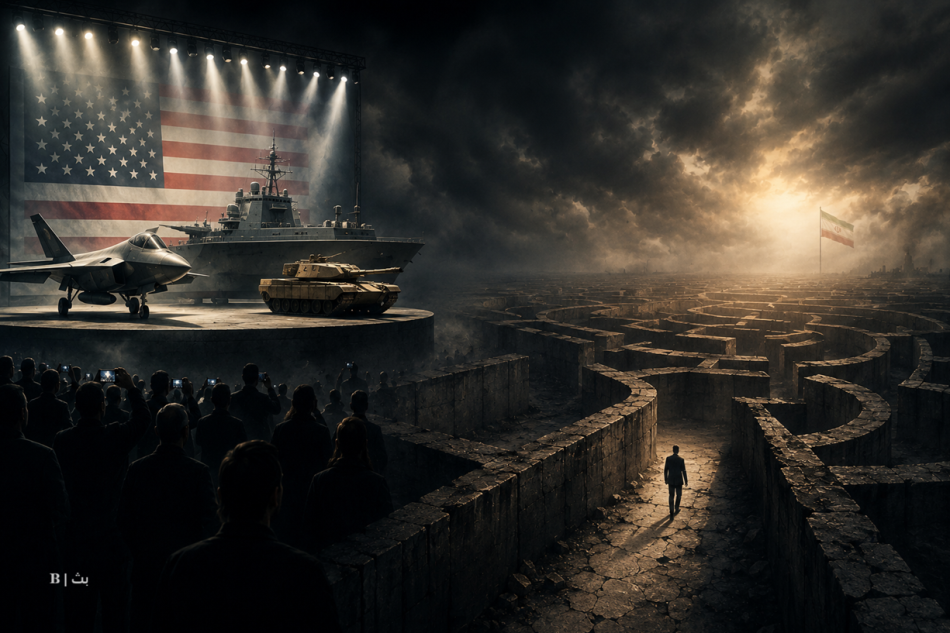
Meanwhile, American reports revealed that the Pentagon has prepared a new list of additional Iranian targets that could be struck if U.S. President Donald Trump decides to resume large-scale military operations. This also falls within the framework of displaying power and maintaining psychological and political pressure on Tehran.
What is striking,
however,
is that American military reports themselves confirm that the next phase would be:
more difficult,
slower,
and far more complex.
U.S. and Israeli information indicates that Iran has moved a large part of its capabilities into:
fortified mountain sites,
mobile platforms,
and decentralized deployment networks,
while relying heavily on:
camouflage,
concealment,
and rapid mobility.
The remaining targets reportedly include:
Shahab, Sejjil, and Khorramshahr missile platforms,
fortified nuclear facilities such as Fordow,
mobile air defense systems,
drone operation bases,
and naval assets near the Strait of Hormuz and Bandar Abbas.
B Analysis
Here, the most important question emerges:
If Iran has been “completely crushed,” as Trump claims,
why does Washington still speak about:
new target lists,
greater difficulties,
and increasingly complicated strikes?
The reality is that modern wars are not measured merely by the number of destroyed sites,
but by:
the opponent’s ability to survive,
reposition,
and prevent its enemy from declaring a “complete ending.”
Trump appears to be seeking four objectives simultaneously:
First:
demonstrating American power to both domestic and international audiences.
Second:
forcing Iran into major strategic concessions without entering a prolonged war of attrition.
Third:
achieving a political and media “victory image” that can be marketed internally.
Fourth:
imposing a new regional peace framework with Israel through force.
But the critical dilemma facing Trump
is that the region is not fully prepared to accept a forced reality, especially amid the continued failure to achieve decisive resolution with Iran, and attempts to exploit escalation in ways many view as closer to political intimidation and deterrence theatrics than a genuine project for stability.
At the same time, Israel’s continued chaotic military policies, and the lack of political wisdom within its government regarding the foundations of genuine and sustainable peace, further complicate the situation, despite the Arab Peace Initiative having offered for years a clear framework for balanced and viable peace.
As for peace through force,
this idea is almost certainly a waste of time, and it will not deliver to Trump what Israel’s war government seeks.
For Trump, decisive victory is not merely a military objective,
but a battle tied to a deeply rooted doctrine involving:
prestige,
image,
and the desire to reshape the region according to his vision.
Meanwhile,
Iran realizes that it has become one of the major tools within the project of imposing peace by force, and it is attempting to exploit this reality as much as possible.
At the same time,
Iran understands that it cannot:
achieve complete victory,
nor accept defeat through negotiations.
Therefore,
it clings to the idea of:
survival,
continuing negotiations,
and presenting itself to the world as:
“a regime that endured and did not collapse.”
Here lies the real contradiction:
between Trump’s ambitions,
Israel’s desires,
the calculations of the Iranian regime,
and the interests of regional states,
particularly the Gulf.
The recent war revealed to the world that the Gulf is no longer merely an oil region,
but a vital center for the stability of:
energy,
the global economy,
supply chains,
and daily human life worldwide.
It also revealed that the Gulf possesses enough power, influence, and capability to become a major player in any future decisive moment if major powers fail to reach a clear conclusion.
From this emerges a strange alignment:
Trump declares that he wants a quick resolution without a comprehensive war,
while Iran seeks prolonged endurance without total collapse.
Thus, the scene sometimes appears to be:
a war of statements,
a display of power,
and media balloons.
But behind this noise lies a far more dangerous reality:
Both sides fear “the final step.”
The true inability may not be:
America’s inability to destroy Iran,
nor Iran’s inability to respond.
Rather,
it may be the inability of the power-showing actors to endure what the world would become after the expected major explosion, if the suspension of decisive resolution and the manipulation of nations’ interests continues.
The world may tolerate statements,
maneuvers,
and military displays for some time.
But it will not remain patient for long when it feels that:
energy,
navigation,
the economy,
food,
and the interests of humanity,
have become hostage to an endless open conflict.
And here lies the most dangerous point:
The greatest fuel for a decisive confrontation is not political rhetoric,
but the growing global feeling that livelihoods and global stability are under threat.
Perhaps neither Trump,
nor Iran’s Revolutionary Guard,
fully calculated the possibility of international exhaustion with empty displays of power.
The coming moments may push the world to care less about slogans such as:
Israel’s security,
the survival of the Iranian regime,
or the mutual media noise.
And care far more about stopping the chaos threatening human life and global stability as a whole.
The most dangerous question now is no longer:
Who is stronger?
But rather:
What comes after the real contours have been revealed?
The near-term outcomes point toward:
continued mutual pressure,
calculated escalation,
and negotiations without complete resolution.
As for the long-term outcomes,
they reveal that the region stands before two choices:
Either:
rebuilding real balances based on stability, development, and shared interests.
Or:
entering a phase of prolonged chaos that exhausts everyone.
The war has also revealed that the Gulf is no longer merely an oil region,
but a global center of gravity for energy, economy, and stability.
Likewise, the policies of the past — based on the United States entering wars and then withdrawing before achieving decisive resolution, leaving burning hotspots to chaos, as happened in Iraq — are no longer successful policies, nor can they be repeated or imposed in the Gulf region.
Therefore,
the world may no longer later ask who will win,
but who can prevent the major collapse of American prestige… before the moment of great سقوط.
In all cases,
the decision for decisive resolution — and ending the chaos — appears to have already been made.
Its signs are becoming visible,
gradually,
or perhaps the full picture may suddenly emerge all at once.
BETH (بث B) – All rights reserved