



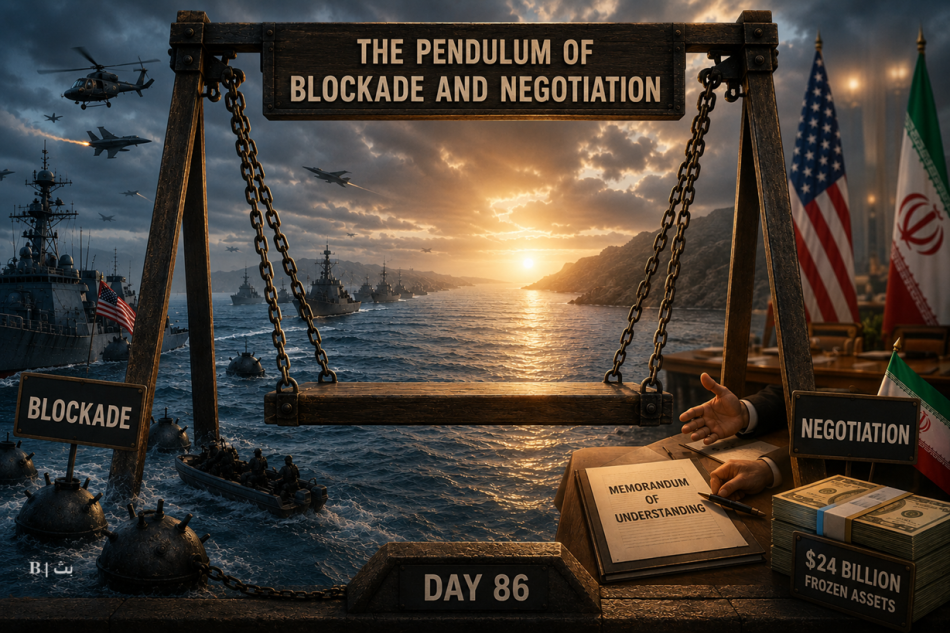
Day 86: The Pendulum of Blockade and Negotiation
Follow-up & Analysis | B | B
In a development highlighting the growing sensitivity of the Gulf maritime theater, U.S. officials revealed that the American strikes targeting southern Iran came after monitoring Iranian military movements described as “potentially threatening” during the 24 hours preceding the attacks.
According to the reported details, U.S. warplanes sank two fast boats belonging to Iran’s Revolutionary Guard while they were allegedly attempting to plant naval mines in the Strait of Hormuz, as American forces continue enforcing a broad naval blockade on vessels heading to or departing from Iranian ports.
The reports also indicated that Iran launched one-way attack drones toward several U.S. naval vessels deployed across the Gulf of Oman and the Arabian Sea, while the U.S. military detected activity involving Iranian air defense systems near the Strait of Hormuz, which was viewed as a direct threat to aircraft and naval units participating in the blockade operations.
Washington responded with what U.S. Central Command described as “self-defense strikes” targeting air defense sites in southern Iran, in a message suggesting that the maritime confrontation is no longer merely a display of force, but part of an open war of attrition centered on deterrence, control, and strategic waterways.
At the same time, Iranian state television announced the full restoration of internet services across the country after months of severe restrictions and near-total disruption linked to the war and security tensions. The move appears to carry dimensions beyond the technical sphere, signaling an attempt to recalibrate the domestic landscape and ease internal pressure.
On the negotiation track, Tehran continues raising the ceiling of its demands, insisting on the release of approximately $24 billion in frozen assets, while demanding that half of the amount be transferred simultaneously with the announcement of the anticipated memorandum of understanding with Washington. Iranian officials are also seeking the transfer of the remaining half within 60 days, under financial and diplomatic arrangements currently under negotiation.
B Analysis
The situation is no longer:
a full-scale war,
nor a genuine peace.
Instead, it has evolved into a complex state of:
maritime pressure,
calculated confrontation,
slow negotiations,
and a test of wills.
Washington appears determined to maintain the blockade without sliding into an all-out war,
while Tehran seeks to prove that it still possesses the ability to disrupt, maneuver, and raise the cost of American pressure.
What stands out even more,
however,
is that both sides continue sending contradictory signals at the same time:
Military escalation,
alongside ongoing negotiations.
Targeted strikes,
paired with discussions of financial understandings.
A naval blockade,
accompanied by economic bargaining.
Here emerges the “pendulum” that now defines Day 86:
neither side wants a total explosion,
and neither side is prepared for a full retreat.
And deep down,
the real question may no longer be:
When will the crisis end?
But rather:
Who will impose the shape of the ending first?
BETH (بث B) – All rights reserved