



Day 85: Strikes Amid Fragile Talks
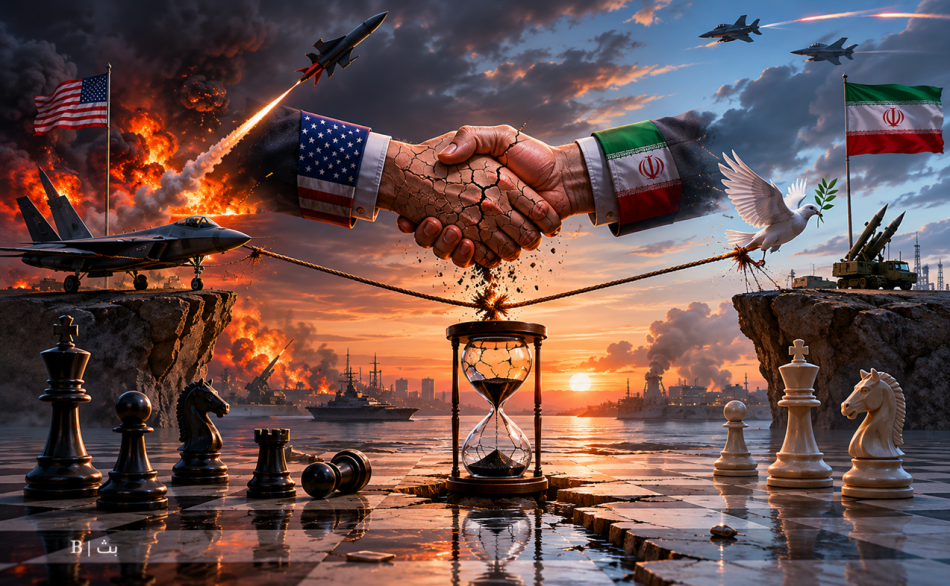
Follow-up & Analysis | B | بث
On Day 85 of the U.S.–Israeli war with Iran and its regional repercussions, military tension once again moved to the forefront, despite the continued talk of:
negotiations,
a ceasefire,
and the possibility of reaching an agreement.
The Brief
U.S. forces targeted boats in southern Iran, along with a surface-to-air missile site in Bandar Abbas, which Washington said had been targeting American warplanes.
U.S. officials confirmed the destruction of two boats, stressing that the strikes were:
“defensive”
and not part of a broader offensive or an end to the fragile ceasefire reached last month.
Alongside the limited escalation, U.S. Secretary of State Marco Rubio said that:
“a deal remains possible,”
noting that discussions are continuing over:
“specific points”
within the initial framework document between the two sides.
He added that the talks held in Qatar still require:
“a few more days”
to achieve tangible progress.
Meanwhile, Chairman of Iran’s Parliamentary National Security Committee, Ebrahim Azizi, warned that any attacks on Iranian armed forces would face:
“a decisive and crushing response.”
However, it was notable that Iran’s official reactions following the U.S. strikes remained relatively restrained so far.
In another development, U.S. President Donald Trump stated that Iran’s enriched uranium would either:
be transferred to the United States for destruction,
or destroyed elsewhere in coordination with Tehran,
as part of the agreement currently under negotiation.
At the same time, Israeli sources revealed that the Israeli military is preparing to expand operations in Lebanon in the coming days, in coordination with the United States, including a possible return to strikes on Beirut and the targeting of senior Hezbollah figures.
B Analysis
The current scene appears to be:
a war that does not want to end,
and negotiations that do not want to fully mature.
The United States is trying to maintain:
military pressure,
without sliding into:
another full-scale war.
That is why Washington describes its strikes as:
“defensive,”
even while striking inside Iranian territory.
On the other side,
Iran continues using:
the language of deterrence,
steadfastness,
and threats,
but still within a carefully calculated ceiling.
The recurring question remains:
Does Iran truly possess the capability for a major response?
Or is the current rhetoric more about:
managing the image of strength,
and preventing any appearance of weakness domestically and internationally?
What stands out is that Tehran — despite the fiery rhetoric — continues to avoid:
a large-scale direct response,
or entering an open confrontation with the United States.
This likely reflects Iran’s awareness of the:
military,
economic,
and political costs,
of any full escalation.
Yet Washington also appears cautious.
The U.S. understands that:
Iran may not be positioned for an open war,
but it still possesses tools of:
disruption,
attrition,
regional proxy activation,
and threats to strategic waterways.
This is why the current phase resembles:
negotiation through fire,
rather than calm diplomacy.
Both sides are operating inside:
a highly sensitive gray zone,
where each seeks to:
increase pressure,
without completely overturning the table.
The most dangerous development, however,
is the renewed Israeli focus on:
Lebanon,
Beirut,
and Hezbollah.
As if the region is gradually moving toward:
expanding pressure fronts,
while negotiations with Iran continue in parallel.
The most dangerous aspect of the current scene
is that everyone speaks of:
peace,
while moving militarily as though preparing:
for another round.
BETH (بث B) – All rights reserved