



Fear of Becoming Extinct
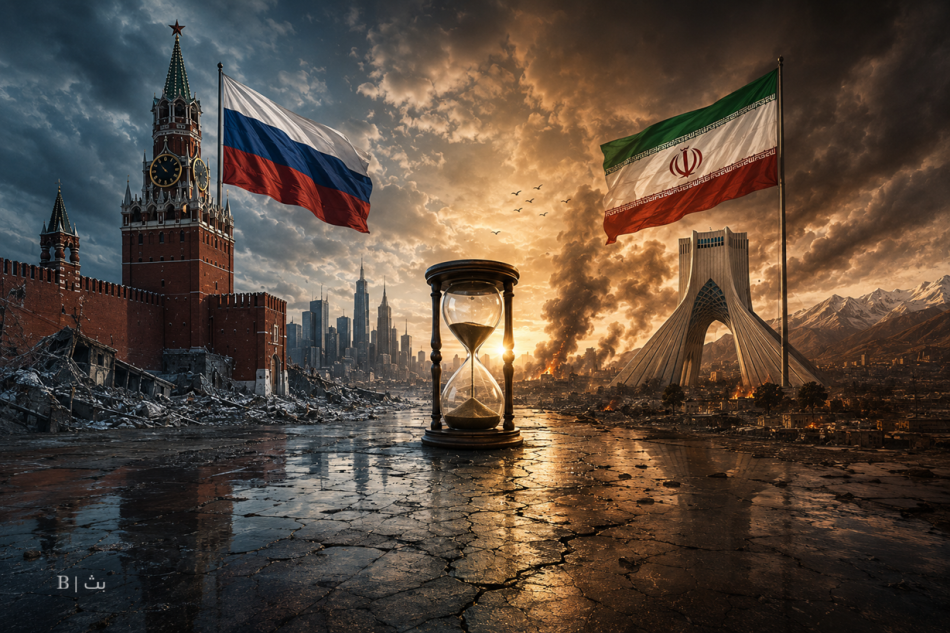
Prepared & Analyzed by | Strategic Media Department – B | بث
Supervised by: Abdullah Alomeirah
At first glance, Russia and the Iranian regime may appear to be two entirely different cases in terms of history, geography, and power.
But a deeper reading reveals a striking similarity between them:
Neither fears defeat alone.
Both fear becoming:
“obsolete systems.”
Russia does not fear losing a battle as much as it fears reliving the moment of the Soviet Union’s collapse.
The Iranian regime, meanwhile, does not fear a nuclear agreement as much as it fears ending up like the monarchy that was overthrown by the revolution.
Here, we are not speaking about temporary political disagreements.
We are speaking about a deep historical fear that governs decision-making itself.
Russia understands that the West did not defeat the Soviet Union through direct war.
It defeated it through long-term erosion:
an exhausted economy,
an arms race,
intellectual isolation,
internal failure,
and a fracture of trust between the state and society.
This is why Moscow today appears to be fighting the ghost of its past before fighting the enemies of the present.
It does not want to be erased from the global equation the way the Soviet Union disappeared from the political map.
The Iranian regime, however, reads history from a different angle.
It has never forgotten that a deeply rooted monarchy collapsed once internal anger accumulated, street dynamics shifted, and the ruling system lost its ability to convince people of its legitimacy.
For this reason, the Iranian regime treats any external concession as a potential internal collapse.
Retreat, in its view, is not merely policy.
It is a fracture in the image of the revolution itself.
Here emerges the idea of “taqiyya” in its political, not merely theological, sense.
That is:
displaying one discourse publicly,
while preserving different calculations underneath.
In negotiations, the Iranian regime may say it accepts de-escalation.
But in reality, it may simply be trying to buy time, preserve the structure of the regime, and reorganize its position.
Not necessarily because it seeks peace,
but because it seeks survival.
This is partly what it shares with Moscow.
Both systems often use politics as a pause within conflict,
not as an end to conflict.
The problem is that both systems possess a deeply troubled historical mindset.
A mindset that does not see compromise as an opportunity,
but as a trap.
And does not see retreat as wisdom,
but as the beginning of collapse.
This is why peace becomes difficult with systems that think in this manner.
Because they do not negotiate in order to leave conflict behind.
They negotiate in order to return to it later under better conditions.
Russia fears becoming an ordinary state after once being an empire.
The Iranian regime fears becoming a closed chapter after presenting itself as an “eternal revolution.”
In both cases,
the past becomes a prison for the future.
The deeper question here is:
Do systems learn from history in order to avoid collapse?
Or do they merely learn how to postpone collapse?
Russia seeks to prevent another Soviet-style disintegration through force.
The Iranian regime seeks to prevent another Shah-style collapse through maneuvering and rigidity.
But the danger is that whoever fights history through fear may unknowingly reproduce the very causes of collapse.
Survival is not achieved through war alone.
Nor through maneuvering alone.
Nor through slogans raised until the final moment.
True survival requires:
internal legitimacy,
a sustainable economy,
a normal relationship with the world,
and the ability to end conflict rather than merely manage it.
This is where the greatest weakness of both Moscow and Tehran lies.
Both are highly skilled at prolonging conflict.
But the question remains:
Can they actually end it?
An ideology that sees the entire world as an enemy cannot create stability.
And a regime that survives only through permanent threat eventually becomes dependent on that threat to justify its own existence.
This is something also seen in other political experiences, including successive Israeli governments that built their survival within the logic of perpetual conflict rather than within a project of lasting peace.
In the end, the similarity between Russia and the Iranian regime is not rooted in the size of their power.
It lies in their fear of destiny itself.
Russia fears becoming nothing more than an old imperial remnant.
The Iranian regime fears becoming an obsolete revolution.
But history shows little mercy to those who believe power alone can prevent collapse.
Sometimes systems fall not because they were defeated in war,
but because they failed to understand the true meaning of survival.
How can these two countries continue without fear?
By:
focusing on building human beings internally,
building reassuring external relations,
and uprooting the culture of:
wars,
chaos,
and permanent revolution,
from the vocabulary of the state itself.
That means:
transforming into systems that create and build,
rather than systems that survive through destruction.
And perhaps such a transformation appears more possible in Russia than under the clerical regime in Iran.
_________
The term “obsolete” here does not refer only to:
a civilization that ended and vanished from existence.
It may also refer to:
a system,
a project,
or a power,
approaching its historical end,
even while trying to survive by any possible means.
History does not speak only of:
civilizations that rose and vanished,
such as:
the Greek,
Pharaonic,
ancient Persian civilizations,
Thamud,
and Al-Ahqaf.
It also speaks of powers that believed sheer force alone was enough to guarantee survival,
only to discover too late that:
fear,
war,
and clinging to the past,
cannot prevent collapse forever.
BETH (بث B) – All rights reserved