

Between Doubt and Certainty
By: Abdullah Alomeirah
The late Prince and poet Badr bin Abdulmohsen once wrote:
If this is farewell… I ask you for two things:
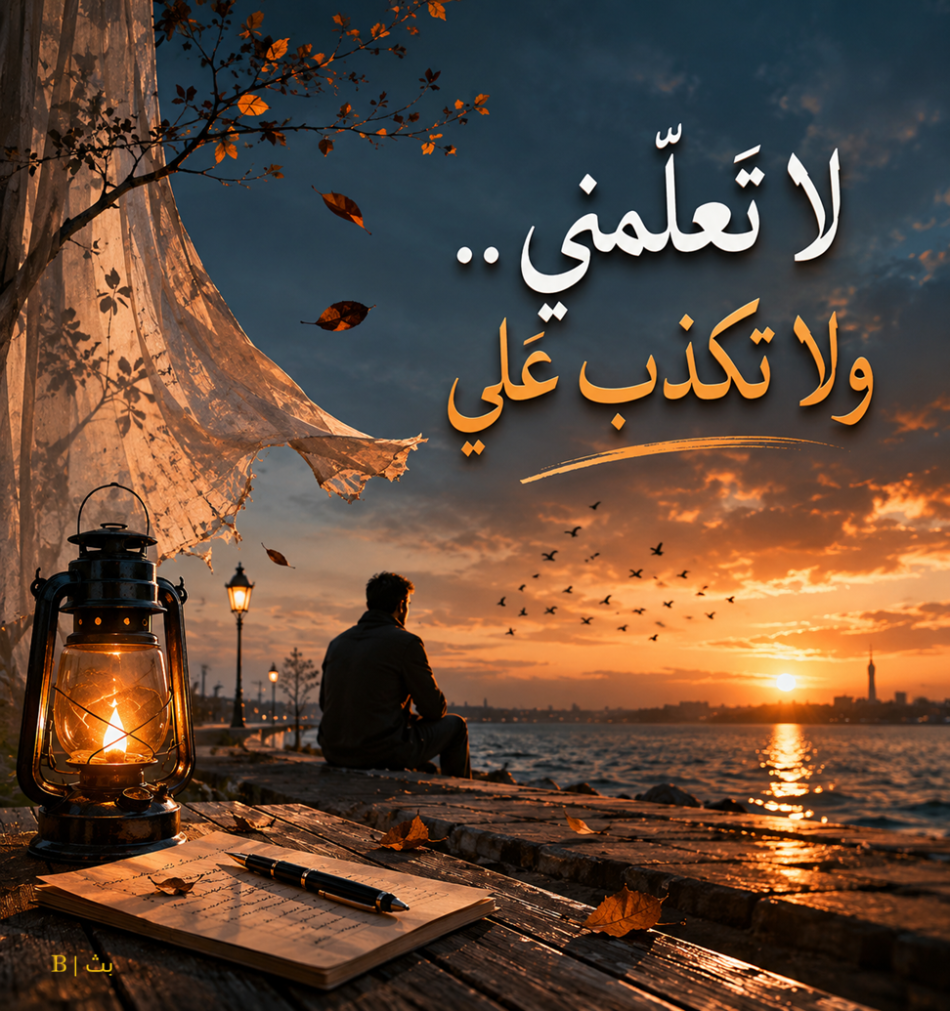
Don’t tell me… and don’t lie to me.Leave me somewhere between doubt and certainty.
Your silence is enough for me… even if you are upset with me.
Two verses — among a larger poem — overflowing with the fire of love, the anxiety of longing, and the human fear of loss.
Yet what makes true poetry remarkable is that it never remains imprisoned within the boundaries of emotion alone.
It possesses a strange ability to travel toward:
politics,
media,
war,
and the human soul itself.
And here lies the brilliance of Badr bin Abdulmohsen رحمه الله.
Yes, he wrote about love.
But he also wrote about a deeply human condition that appears across countless dimensions of life.
Take media, for example:
How often does the public feel that there is a hidden truth… yet no one fully reveals it?
How often do people find themselves trapped between:
doubt,
certainty,
interpretation,
and silence?
Here, the verse:
“Don’t tell me… and don’t lie to me”
becomes a precise description of humanity’s relationship with truth itself.
In other words:
Do not shock me with a harsh truth delivered without wisdom.
But do not deceive me with cheap propaganda either.
Allow me to approach truth consciously:
not through shock,
and not through manipulation.
As for his words:
“Leave me somewhere between doubt and certainty”
they perfectly resemble the condition of societies during:
wars,
crises,
and media disinformation.
People begin living inside a foggy space:
they sense that something is not right,
yet they do not possess the full truth.
And so silence itself sometimes becomes:
a political language,
a media language,
and even a psychological language.
More dangerously, some regimes — and some media outlets — deliberately keep people:
“between doubt and certainty.”
Because when human beings lack complete certainty,
they remain:
hesitant,
fearful,
and easier to direct.
Even in international relations, these verses can be applied in astonishing ways.
Some states do not truly want:
total war,
nor complete peace.
Instead, they prefer keeping everyone trapped inside a gray zone:
threats without resolution,
negotiations without trust,
partial truths,
and silence loaded with hidden messages.
And here, poetry becomes larger than a love story.
It becomes:
an anatomy of the human soul,
of politics,
of media,
and sometimes of the ways people themselves are managed.
Yet despite all these interpretations, the true heart of the verses remains:
love.
A love afraid of separation.
A heart unable to bear the full truth, yet unwilling to accept lies.
And so the poet asks for something profoundly human:
to remain suspended between:
hope,
pain,
doubt,
and certainty.
Because some lovers do not want a clear ending.
For clarity, sometimes, means the death of the dream itself.
And here lies the genius of Badr bin Abdulmohsen رحمه الله:
he did not write love merely as joy,
but as that painful distance between:
the fear of departure,
attachment to those we love,
and the desire to delay the truth…
even through silence.
And finally…
A heart filled with love and life can rarely coexist comfortably with killing, war, or scenes of destruction.
For when a human being is filled from within with:
love,
awareness,
and humanity,
they become more inclined toward life,
and less capable of reconciling themselves with cruelty.
And perhaps this is where love ultimately triumphs —
not merely as a romantic emotion,
but as a value that makes humanity more merciful toward the world.