


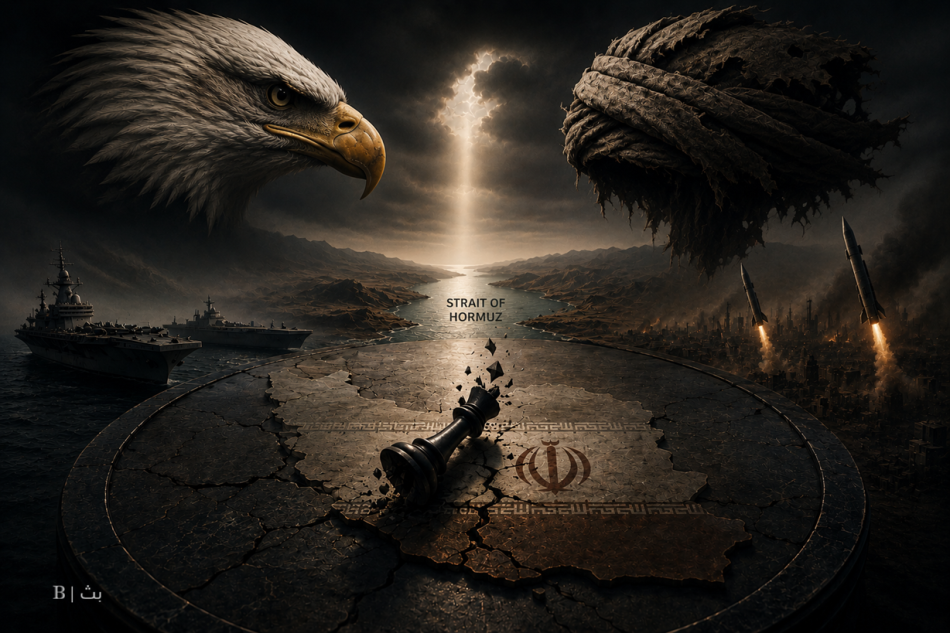
Why Isn’t Iran Being Struck?
By: Abdullah Alomeirah
When many people ask the question:
Why hasn’t the confrontation with Iran been decisively settled?
the usual explanations immediately appear:
international balances,
fear of a wider war,
oil prices,
NATO’s position,
Gulf calculations,
the global economy,
and concerns over regional chaos.
But after more than eighty days of escalation,
and after the first wave of American and Israeli strikes,
it has become increasingly clear that many of these explanations no longer convince serious observers.
What happened on the ground demonstrated something unmistakable:
the Iranian regime suffered painful blows,
a significant portion of its military and security capabilities was shaken,
and the true balance of power is nowhere near equal, despite Tehran’s attempts to portray it otherwise.
Today’s reality does not resemble:
a power confronting another equal power,
but rather:
a superpower exercising extreme caution toward an opponent far weaker than itself.
And here lies the real dilemma.
The issue is not America’s ability — or that of its allies — to strike Iran.
The issue is:
the way the strikes are being managed.
Limited attacks,
open-ended negotiations,
and hesitant messaging,
have granted the Iranian regime valuable space to rebuild its image before both the Iranian people and the wider world.
Tehran understood early on that simply remaining standing after the strikes
would allow it to claim:
“We are still confronting America as an equal.”
While the actual reality is entirely different.
The Revolutionary Guard and what remains of the clerical system
are far too weak to defeat the United States or its allies militarily.
Yes,
they can inflict damage.
They can ignite proxy fronts.
They can activate militias and regional networks.
But there is a massive difference between:
the ability to cause disruption,
and the ability to achieve victory.
Anyone who truly understands the nature of the Iranian regime
knows that the issue goes far beyond nuclear files or maritime routes.
The Iranian regime is not built merely on weapons.
It is built on:
revolutionary ideology,
political deception,
manufactured prestige,
the export of crises,
and the creation of permanent enemies to justify its own survival.
That is why prolonged appeasement does not produce real change.
It merely gives the regime more time to reposition itself.
The ruling clerics do not view negotiations as the end of conflict,
but rather as a phase for:
managing losses,
buying time,
and searching for the next opportunity.
For this reason,
any agreement that does not directly dismantle:
the structure of the Revolutionary Guard,
the ideology of the revolution,
and the regime’s transnational networks of influence,
may become little more than a temporary truce rather than a genuine solution.
The greater problem is that some Western capitals still deal with Iran under the mindset of:
“How do we reduce the danger?”
rather than:
“How do we eliminate the roots of the danger?”
And here lies the difference between:
containing a crisis,
and resolving a crisis.
Today’s Iran is not simply a conventional state engaged in political disagreements with the West.
It is an ideological project that views retreat as an existential defeat.
That is why,
for the ruling clerics,
raising the white flag would not merely mean political loss,
but the collapse of the entire narrative upon which the regime was built since the revolution.
This explains Iran’s persistent strategy of:
maneuvering,
denial,
and prolonging time,
even in its weakest moments.
The most dangerous question today is not:
Can America strike Iran?
But rather:
Does America truly want to end the Iranian project completely?
Or does it merely seek to manage the threat within calculated limits?
Because the difference between those two choices
will shape the future of the entire Middle East.
The big question at this stage:
What is Trump thinking about?.. And what exactly does he want?
BETH (بث B) – All rights reserved