


Day 82: Washington Narrows the Distance
Follow-up & Analysis | B | بث
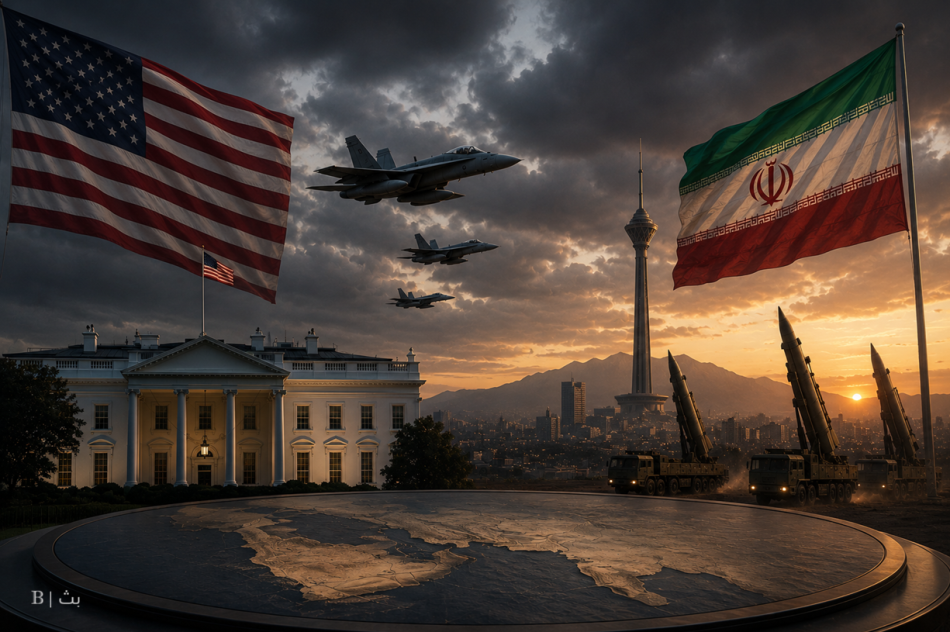
The U.S.–Israeli war with Iran is entering an extremely sensitive phase, amid mounting political and military signals tied to the fate of ongoing negotiations, as American warnings continue to intensify regarding Iran’s nuclear file and the Strait of Hormuz.
White House spokesperson Anna Kelly reaffirmed what she described as President Donald Trump’s “red lines,” stressing that Iran “must never be allowed to possess a nuclear weapon or retain highly enriched uranium.”
In the same context, U.S. Secretary of State Marco Rubio stated that Washington still prefers reaching an agreement, but clearly emphasized the need for “an alternative plan” should Tehran refuse to reopen the Strait of Hormuz.
Meanwhile, Pakistani efforts aimed at narrowing the gap between the two sides continue, with Pakistan’s Army Chief Asim Munir arriving in Tehran as part of the ongoing mediation between Washington and Tehran.
The Brief
Tensions deepened further after President Donald Trump canceled his vacation in New Jersey and abruptly returned to Washington, coinciding with media reports suggesting that the White House is considering resuming strikes against Iran.
Speculation intensified after Trump announced he would not attend the wedding of his eldest son, Donald Trump Jr., explaining on his Truth Social platform that “government-related circumstances” required him to remain in Washington during “this important period.”
B Analysis
The current scene does not appear to be mere media escalation, but rather a final pressure phase in which:
political messaging,
military movements,
and even the personal signals sent by the U.S. president,
are all being used within an exceptionally complex negotiating equation.
Trump’s sudden return to Washington and his decision to skip a major family occasion are not simply protocol-related details; they carry a dual psychological and political message:
to the American public,
and to Tehran at the same time.
Washington appears to be signaling:
the negotiation window remains open,
but time is running out.
At the same time, Iran understands that the two decisive issues in any potential agreement have now become:
highly enriched uranium,
and the Strait of Hormuz.
Pakistan’s increasingly active mediation role also reflects a growing regional realization that any collapse of negotiations could push the region into a far more dangerous phase, particularly given the sensitivity of maritime routes and global energy markets.
So far,
there are no definitive indications of either war or a successful agreement.
What is certain, however,
is that the tempo is accelerating,
and that the coming hours may prove to be among the most sensitive moments since the crisis began,
despite the prevailing atmosphere of mutual distrust.
Agreement Nears.. Trump Holds Firm on Terms
Indicators are increasingly pointing toward a potential agreement between Washington and Tehran, amid reports suggesting that the remaining disputes are now centered on:
the wording of certain clauses,
implementation guarantees,
and mechanisms of compliance between both sides.
At the same time, U.S. President Donald Trump maintained his hardline tone, declaring:
“I will only sign what I want.”
The Brief
Available indications suggest that negotiations have entered an extremely sensitive phase after narrowing gaps on several key issues related to:
highly enriched uranium,
the future of sanctions,
the Strait of Hormuz,
and the role of international oversight.
Despite the relatively positive atmosphere, “mutual distrust” remains the dominant element between both parties, especially after months of:
military escalation,
reciprocal strikes,
and contradictory political messaging.
B Analysis
When negotiations reach the stage of:
“disagreements over wording,”
it usually means that the general framework of an agreement already exists.
But in major crises, words are never mere linguistic details.
They become:
maps of power,
spaces of influence,
and loopholes that may later be exploited.
This is why both sides cling tightly to the wording of clauses, because every phrase may carry:
a different interpretation,
a different obligation,
or an opening for future maneuvering.
Trump’s statement:
“I will only sign what I want,”
also carries more than one message.
A domestic message to the American public that:
he has not retreated,
and has not offered free concessions.
And a message to Iran that:
the White House still negotiates from a position of strength,
even as an agreement appears closer.
At a deeper level, however, both sides seem to have reached a shared realization:
that the cost of continued confrontation has become higher than the cost of an agreement,
even if that agreement proves fragile or temporary.
The key question now is no longer:
Will an agreement happen?
But rather:
How long will such an agreement survive,
and how many doubts will remain hidden behind its wording?
An Arab analyst believes that any potential agreement with Iran would not fully change the core of the problem.
Even with political or nuclear understandings, the Iranian regime’s underlying conviction — in his view — would remain centered on:
exporting the revolution,
expanding influence within parts of the Arab and Islamic worlds,
and using regional proxies as an integral part of the project’s philosophy.