



Day 81: The Draft of the Deferred Knot .. and Its Implications
Follow-up & Analysis | B
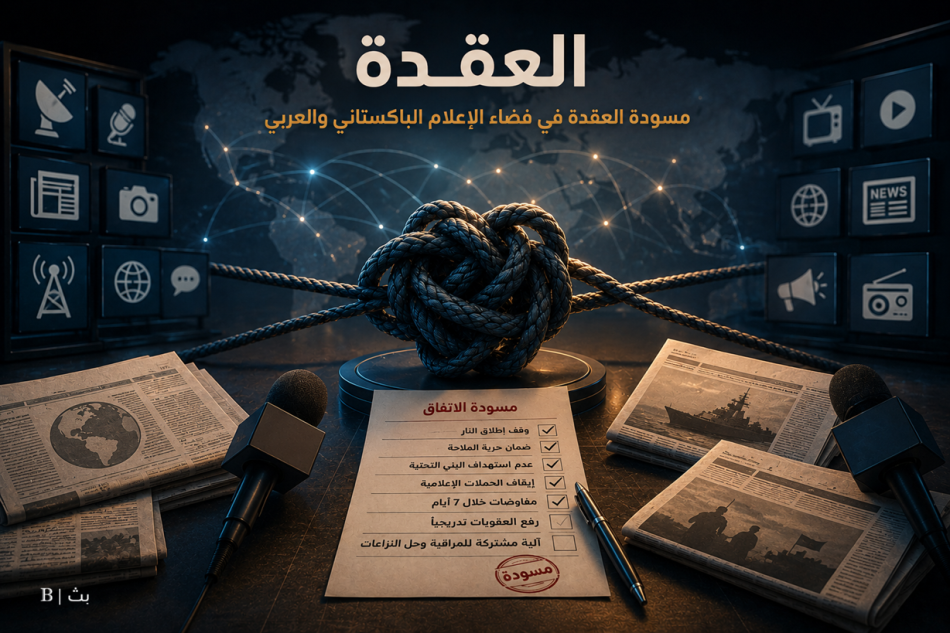
Political and media circles are circulating information about a potential U.S.–Iran draft agreement that includes:
- A ceasefire,
- Guaranteeing freedom of navigation in the Arabian Gulf, the Strait of Hormuz, and the Gulf of Oman,
- Not targeting interests and infrastructure,
- Halting media campaigns,
- Launching negotiations on unresolved issues within 7 days,
- Alongside a gradual lifting of U.S. sanctions in exchange for Tehran’s commitment to the agreement’s terms, and the establishment of a joint mechanism for monitoring and dispute resolution.
Leaks also indicate that the agreement would enter into force immediately upon official announcement by both sides, should a final formula be reached.
At the same time, Pakistan continues its efforts to bridge viewpoints, as Pakistani Interior Minister Mohsin Naqvi met once again with Iranian Foreign Minister Abbas Araghchi in Tehran, two days after delivering a new American message to the Iranians.
Pakistan’s Army Chief Asim Munir had been expected to visit Tehran if a real breakthrough had occurred, but the visit has not taken place so far, reflecting the persistence of fundamental gaps.
The Real Knot
Despite talk of a draft agreement, the essence of the crisis remains tied to two highly sensitive files:
- Highly enriched uranium,
- And the Strait of Hormuz.
Washington categorically rejects:
- The retention of highly enriched uranium stockpiles inside Iran,
- And any formula granting Tehran influence or control over the Strait of Hormuz.
In contrast, Iran appears to be attempting to turn these two files into strategic negotiating cards rather than merely technical clauses.
B Analysis
The circulating draft appears closer to:
- A temporary de-escalation framework,
- Rather than a final settlement agreement.
The focus on:
- Halting media campaigns,
- Guaranteeing navigation,
- And avoiding attacks on infrastructure,
reflects an attempt to reduce tension and manage the conflict more than a final treatment of the roots of the crisis.
The most important question:
Are these genuinely Iranian demands in exchange for accepting American and Israeli conditions?
Or are they part of a familiar Iranian strategy based on:
- Prolonging negotiations,
- Buying time,
- And keeping major files suspended until the very last moment?
The scene suggests that Tehran is still maneuvering within a calculated margin:
- Neither full rejection,
- Nor full acceptance.
Meanwhile, Washington appears cautious about offering concessions that could be interpreted as implicit recognition of Iran’s right to retain elements of strategic power.
What is also striking is that media and military escalation inside Iran has not actually receded. Tehran has, in recent days, transformed into a platform for psychological and military messaging through war-themed billboards, Revolutionary Guard training displays, and even the involvement of women and children in scenes of mobilization and weapons training.
This reflects that Iran:
- Is negotiating,
- While at the same time keeping the possibility of escalation present in both domestic and international consciousness.
So far, it does not appear that the agreement has truly been born. Rather, the region remains inside a “testing zone”:
- A test of wills,
- A test of the ability to impose conditions,
- And a test of who becomes exhausted first behind the negotiating table.
What Does Leaking This Draft to Pakistani and Gulf Media — Rather Than American Media — Mean?
It appears that leaking this draft may serve more than one objective at the same time, especially in major files managed through:
- Pressure,
- Psychological messaging,
- Testing reactions,
- And not merely through diplomatic texts.
B Analysis
First: Testing Public Opinion and Elites
Drafts are sometimes leaked to determine:
- How the Iranian public will react,
- How American and Israeli media will handle them,
- And whether there is public or political rejection or acceptance of certain sensitive clauses.
Especially in files such as:
- Uranium,
- Hormuz,
- And sanctions.
Because the decision here is not merely technical, but tied to the image of “victory or retreat” before the public.
Second: Indirect Negotiating Pressure
The leak may be a message to the other side saying:
“These are the possible limits for now.”
In other words, an attempt to psychologically and politically push the opposing side toward acceptance, or hold it responsible for obstruction if negotiations later collapse.
This is why we sometimes notice:
- Each side allowing a slightly different version to leak.
Third: Reassuring Markets and the World
Merely discussing:
- Freedom of navigation,
- De-escalation,
- And avoiding attacks on infrastructure,
sends direct messages to:
- Oil markets,
- Shipping companies,
- And capitals concerned about a wider explosion.
Even before any actual agreement is signed.
Fourth: Buying Time
Leaks are sometimes part of time management:
- Temporarily lowering tensions,
- Preventing rushed military reactions,
- And keeping the negotiation door open.
Here emerges the question you raised:
Is Iran maneuvering to buy time?
Or does America also need time to avoid a larger explosion?
Perhaps both.
Fifth: Preparing Public Opinion for Painful Concessions
Some clauses cannot be introduced suddenly.
Therefore, leaks are used as a stage of gradual “psychological normalization,” so that the idea becomes less shocking when officially announced.
Especially if the final agreement includes:
- Iranian concessions on enrichment,
- Or American concessions regarding sanctions and regional influence.
The Most Important Conclusion
When drafts are leaked in files like these, it usually means:
- The battle has not ended yet,
- But has moved from closed rooms…
- To a war of messages, signals, and perception management.
So far, there does not appear to be a complete official document publicly published for the draft.
Rather, what is circulating consists of:
- Fragmented leaks,
- And information from diplomatic and media sources,
- Passed through several Western and regional media outlets.
Most notably, Reuters was among the first Western agencies to speak about:
- The existence of a framework agreement or exchanged proposals through Pakistani mediation,
- Focusing on Hormuz, highly enriched uranium, lifting sanctions, and de-escalation.
The Guardian also discussed some details of the disputed points, especially:
- The idea of managing the Strait of Hormuz,
- Transferring uranium,
- And the security guarantees requested by Iran.
As for the details closest to actual “draft clauses,” they appeared through:
- Pakistani and Gulf media outlets, including Al Arabiya,
- Political platforms on X and Instagram,
- And smaller news websites citing what they described as “leaks” from mediators.
But what is striking is that major American media outlets such as:
- The New York Times,
- The Washington Post,
- And CNN,
have not yet published a full text or a confirmed document of the draft.
And this is highly significant.
Because what is being leaked right now appears closer to:
- “Negotiation trial balloons,”
- Rather than an official leak of a final document.
The closest reading of the scene so far is:
- That there are several circulating versions or concepts,
- Not one unified final version.
This is why we notice differences in some clauses from one outlet to another, especially regarding:
- The duration of enrichment freezes,
- The fate of uranium,
- The structure of Hormuz management,
- Security guarantees,
- And the nature of sanctions relief.
Final B Analysis
This type of leak is rarely accidental.
When clauses are leaked in fragmented form, through multiple outlets, this suggests that:
- Each side is attempting to manage the narrative gradually,
- And test international reactions,
- Without fully committing to a final text.
In other words:
The leak here is not merely a “disclosure of information,”
but part of the negotiation process itself.