



Day 79: Silence in Washington .. Noise in Tehran
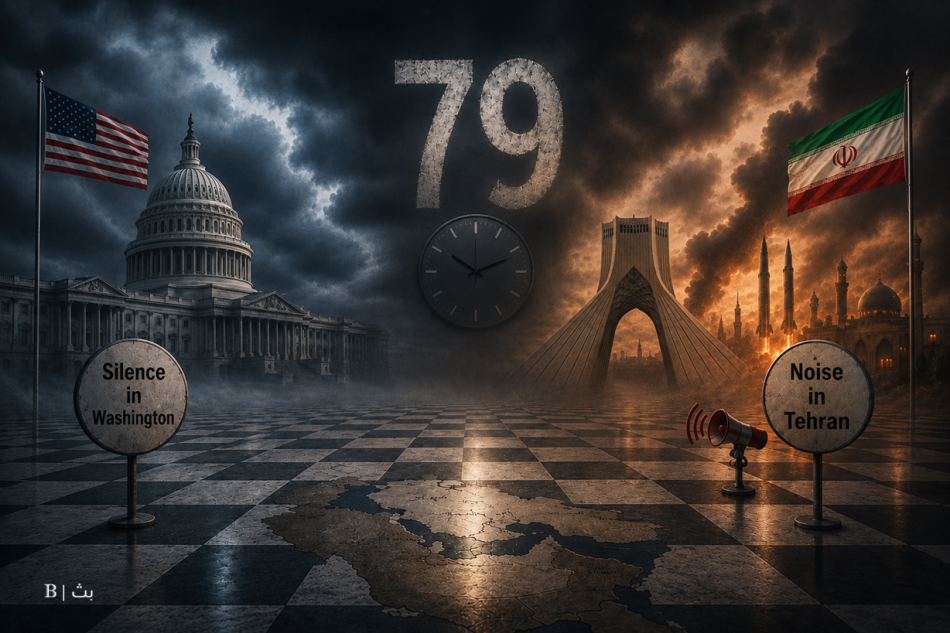
Follow-up & Analysis | B | B
Day 79 appears noticeably different from the previous stages of the U.S.–Iran confrontation.
The American tone seemed quieter — almost silent politically and militarily — compared to weeks of escalating threats and pressure, while the Iranian voice grew louder through a series of warnings and statements interpreted as an attempt to provoke Washington or test the boundaries of the new American position.
This comes after U.S. President Donald Trump announced the postponement of what was described as an imminent strike that was expected to take place on Tuesday, before Saudi, Qatari, and Emirati mediation efforts pushed toward granting diplomacy another opportunity.
Trump confirmed his respect for the requests for de-escalation, stating that delaying the “strongest attack” was intended to leave room for Iran to step back and respond to American demands, particularly regarding its nuclear program and regional conduct.
The Brief
Meanwhile, Iran escalated its military rhetoric.
An Iranian army spokesperson stated that Tehran considers the current ceasefire period “a period of war,” adding that Iranian forces had used the pause to strengthen their combat capabilities.
Iran also threatened to “open new fronts” if the United States resumes its attacks, reflecting a continued strategy of psychological pressure and deterrence signaling.
According to U.S. intelligence assessments, Tehran has restored operational capability at 30 out of 33 missile sites along the Strait of Hormuz, reviving concerns over maritime security and the safety of U.S. naval forces in the Gulf.
The assessments further indicated that Iran still retains around 70% of its mobile launch platforms, in addition to nearly 70% of its pre-war missile stockpile, including ballistic and cruise missiles.
Reports also noted that nearly 90% of Iran’s underground missile storage and launch facilities — known as “missile cities” — are at least partially operational again, despite months of American and Israeli strikes targeting them.
Despite the tense atmosphere, Trump confirmed that there had been “a very positive development” in talks with Iran, expressing optimism about reaching an agreement that would prevent Tehran from obtaining a nuclear weapon.
The U.S. president also revealed that Israel had been informed of the decision to delay the strike in order to give diplomacy one final opportunity before any renewed escalation.
B Analysis
The current scene no longer resembles the period before the war,
nor does it resemble a moment of genuine peace.
Washington appears to be:
lowering its voice…
without lowering its readiness.
Tehran, meanwhile,
is raising its voice…
because it understands that American silence this time may not necessarily mean retreat, but perhaps a calculated wait for a more decisive moment.
The visible contradiction between:
American calm,
and Iranian noise,
reveals that both sides are operating within an extremely sensitive space:
no full-scale war for now,
yet no complete agreement either.
At a deeper level,
the Gulf appears to have succeeded — temporarily — in buying time.
But the more dangerous question remains:
Is the American silence the beginning of real de-escalation?
Or the calm before the largest strike yet?
So far today — at least publicly — the day has remained largely absent of any new Trump statements, aside from remarks previously circulated.
The latest development at this moment comes from Israeli media, reporting that a phone call took place yesterday (Tuesday) between Donald Trump and Benjamin Netanyahu.
Washington and Tel Aviv… The Call of Decision
Describing the call as “the longest and most decisive” suggests that the discussion went far beyond routine political coordination, entering instead a phase of:
decision-making,
or drawing the final lines before a new stage begins.
The unusual length of the conversation likely reflects:
the complexity of the files under discussion,
and the scale of disagreements or sensitive calculations involved,
particularly regarding:
the Iranian file,
the future of the postponed strike,
the limits of Israeli action,
and the path of U.S. negotiations.
In most cases,
when conversations between leaders are described in such terms,
the world is not simply facing “a lengthy discussion”…
but rather a moment that may precede a major turning point.
Final Opportunity
U.S. President Donald Trump said Wednesday evening that the United States would give negotiations with Iran “a final opportunity,” adding that he is “not in a hurry.”
Trump told reporters:
“We are in the final stages with Iran.. We’ll see what happens. Either we make a deal, or we’ll do some slightly bad things, but I hope that doesn’t happen.”
He also stressed the need to reopen the Strait of Hormuz, saying:
“We have to open the Strait of Hormuz, but I’m not in a rush.. I’m not in a hurry regarding Iran.”
Trump also expressed confidence that Israeli Prime Minister Benjamin Netanyahu would support any course of action Washington chooses toward Iran, adding:
“He’ll do whatever I ask him to do.”
A Few Days
In his latest remarks tonight, Trump said that Washington is currently dealing with:
“people in Iran who have logic,”
noting that they now have to:
“sign the deal,”
while confirming that he is willing to wait:
“a few days.”
Trump added:
“We will not ease anything before the agreement is signed.”
B Analysis
The statements reveal that Washington still sees an opportunity to reach an agreement,
but under:
maximum pressure,
not free de-escalation.
The phrase:
“people who have logic”
also suggests that the U.S. administration believes there is a current inside Iran inclined toward a settlement or toward avoiding escalation.
At the same time,
his reference to:
“waiting a few days”
reflects Washington’s unwillingness to close the negotiation door quickly,
while maintaining:
sanctions,
pressure,
and deterrence,
without offering any relief before a formal agreement is signed.
Trump appears, through these statements, to be attempting to combine:
pressure,
deterrence,
and keeping the negotiation door open.
That is why his call for:
“opening the Strait of Hormuz immediately”
came alongside:
“I’m not in a hurry regarding Iran.”
The message here does not appear contradictory,
but rather reflects a distinction between:
the strategic objective,
and the timing of execution.
The United States considers freedom of navigation in Hormuz a fixed strategic goal,
but carrying that out through full-scale military force is not currently viewed as an urgent decision.
Trump’s repeated use of the phrase:
“I’m not in a hurry”
also suggests an attempt to avoid appearing as a party rushing toward another war,
while keeping the threat active as a negotiating pressure tool.
BETH (بث B) – All rights reserved