


Council of Ministers Chaired by King Salman .. Managing Domestic and Regional Files with Confidence
- Saudi Arabia Affirms: Protecting Security and Stability Is a “Red Line”
- Unified Gulf Support to Confront Regional Challenges
- “Makkah Route” Initiative Expands to More Than 1.2 Million Pilgrims
- Full Operation of Riyadh Metro Stations Completed
- New Decisions in Transport, Justice, Artificial Intelligence, and Environment
- Saudi-Spanish Strategic Partnership to Enhance Investment and Cooperation
- Approval of Regulations Protecting Whistleblowers, Witnesses, Experts, and Victims
Jeddah | BETH | B
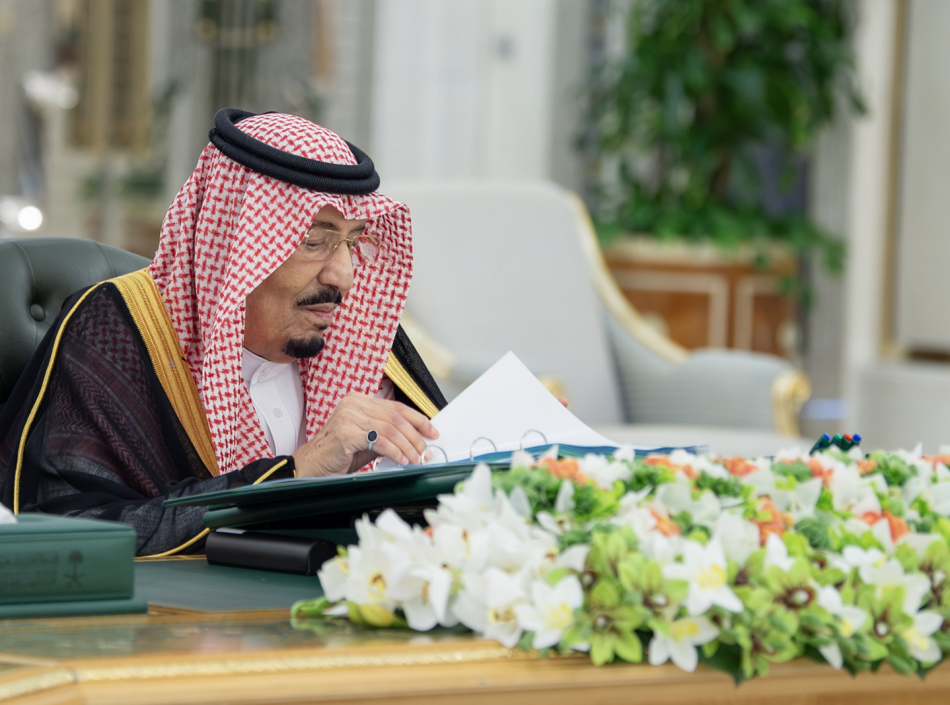
Custodian of the Two Holy Mosques King Salman bin Abdulaziz Al Saud chaired the Council of Ministers session held in Jeddah on Tuesday, in a meeting that carried parallel security, developmental, and strategic messages, reflecting the Kingdom’s continued management of its domestic and regional files with confidence and stability amid a phase of rapid transformations across the region and the world.
The session reviewed operational readiness for the 1447 AH Hajj season and the progress achieved under the Pilgrims Experience Program, alongside continued Gulf and security coordination, while reaffirming the Kingdom’s commitment to taking all necessary measures to protect its security, stability, and the safety of citizens and residents on its territory.
The Council also discussed regional and international cooperation files, the expansion of economic and investment partnerships, as well as a package of regulatory and developmental decisions covering transport, justice, environment, intellectual property, and civil aviation.
Overview
Regarding Hajj preparations, the Council reviewed the implementation paths of operational plans for this year’s Hajj season and efforts aimed at enhancing services provided to pilgrims, while continuing the expansion of the “Makkah Route” initiative, which has benefited more than 1.2 million pilgrims across 10 countries and 17 international entry points.
On the regional level, the Council reviewed the outcomes of the phone calls conducted by Crown Prince Mohammed bin Salman with the President of the United Arab Emirates and the Emir of Qatar, including discussions on regional developments and joint coordination to strengthen regional security and stability.
The Council reaffirmed Saudi Arabia’s support for the outcomes of the emergency meeting of GCC Interior Ministers, emphasizing that Gulf security is “indivisible” and stressing the importance of strengthening joint coordination in confronting current regional challenges.
In the economic and developmental sphere, the Council approved several agreements and memorandums of understanding with multiple countries, including:
- Kuwait in export development,
- Spain in strategic partnership,
- Djibouti and India in customs cooperation,
- Thailand in judicial cooperation,
- Morocco and Tunisia in cultural and linguistic cooperation,
- in addition to agreements in civil aviation and intellectual property.
The Council also approved the adoption of the GCC railway linkage agreement, in a step aimed at enhancing Gulf economic and logistical integration.
Domestically, the Council praised the completion of operations across the main stations of the Riyadh Metro, considering the project an extension of the Kingdom’s broader path toward infrastructure development and quality-of-life enhancement in line with Vision 2030 objectives.
The Council also commended Saudi students for winning 24 awards at ISEF 2026, reaffirming the Kingdom’s growing global presence in innovation and scientific excellence.
Among the most prominent regulatory decisions:
- approving the executive regulations for the Protection of Whistleblowers, Witnesses, Experts, and Victims System,
- amending the regulatory framework for water factories,
- and approving final accounts for several government and strategic entities.
Analysis | BETH | B
The session clearly reflected that the Kingdom is moving simultaneously on three parallel tracks:
- strengthening security and stability,
- accelerating development and economic integration,
- and reinforcing the image of a state capable of managing major files with steadiness and composure.
The security messages delivered during the session were particularly clear amid current regional tensions, as the Council stressed that the Kingdom “will never hesitate” to take all necessary measures to protect its security and stability. This language carries a calculated deterrent dimension, while simultaneously reflecting confidence in Saudi Arabia’s military and security capabilities.
At the same time, the Kingdom did not focus solely on security. It continued advancing infrastructure, transport, economic, and knowledge projects — reflecting an emerging Saudi philosophy that:
“True stability is built not only through strength, but also through development.”
The expansion of the “Makkah Route” initiative, the full operation of the Riyadh Metro, and the GCC railway linkage project all indicate that the Kingdom is moving from a phase of isolated projects toward a phase of “engineering integrated systems.”
Externally, the growing number of agreements and partnerships demonstrates that Saudi Arabia is moving confidently toward expanding its economic and diplomatic influence — not only as an oil power, but as a regional hub for investment, logistical connectivity, cultural cooperation, and strategic influence.
At a deeper level, the session appeared to send a dual message:
- the Kingdom continues building regardless of escalating challenges,
- while simultaneously maintaining full readiness to protect its security and interests.
This equation in particular — development alongside deterrence — has become one of the defining features of the new Saudi era.