



Playing in Injury Time
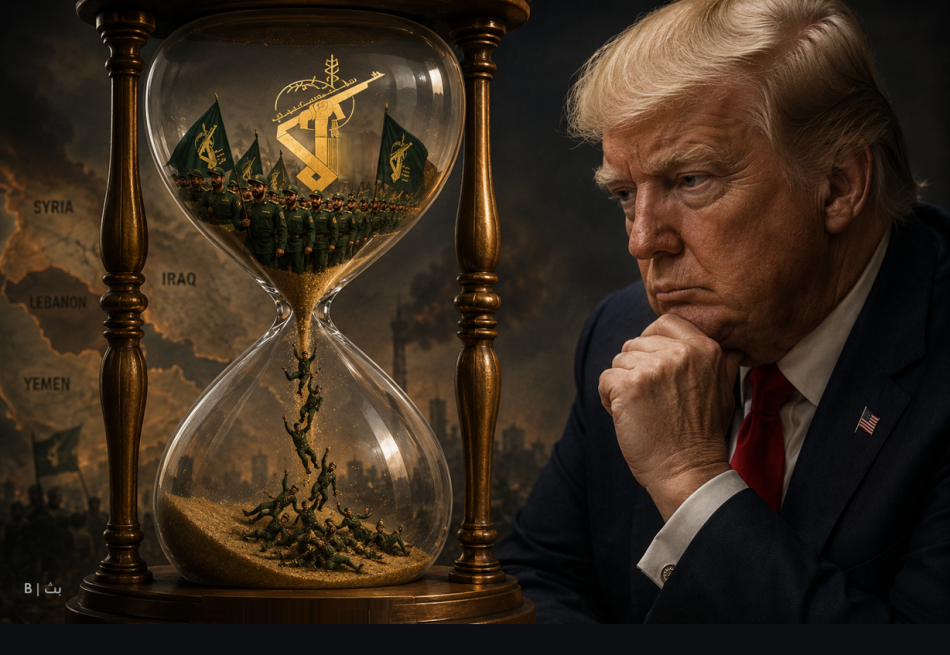
What Does Iran Want from Playing for Time?
Analysis by the Strategic Media Department – BETH | B
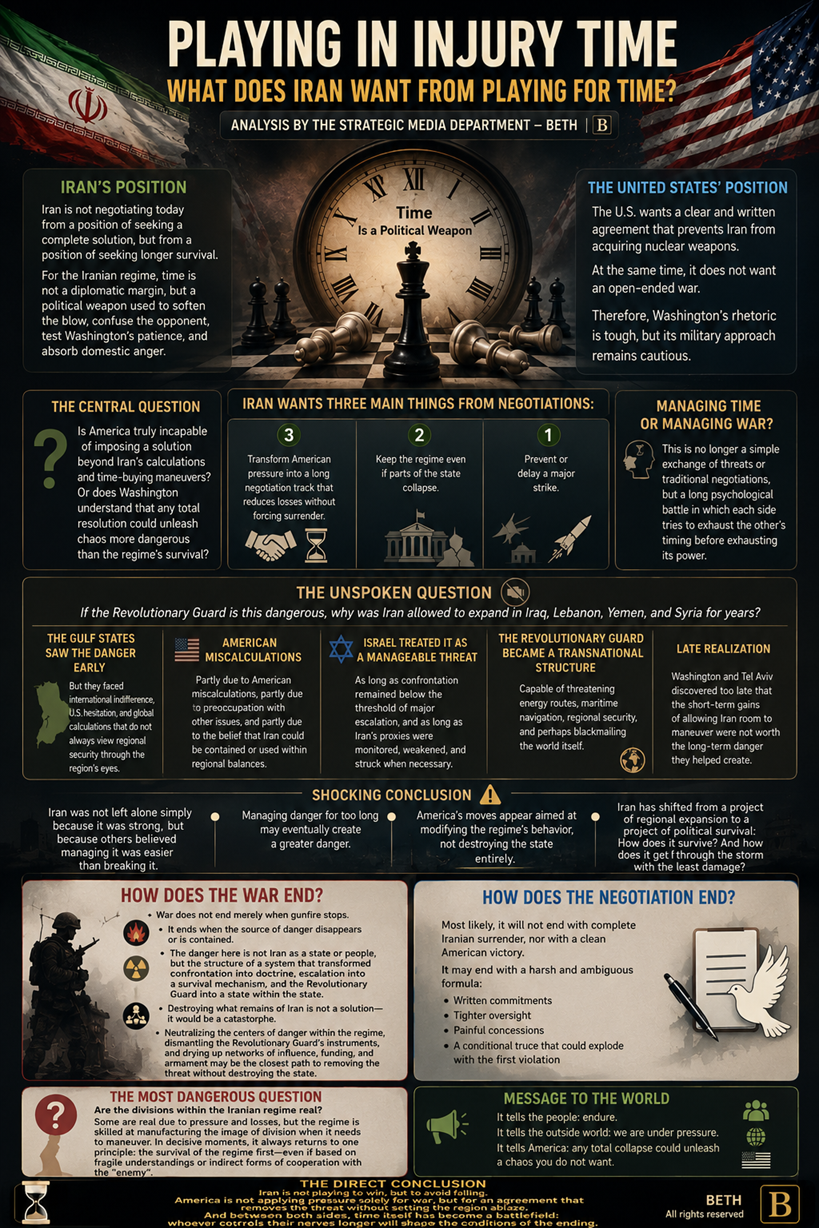
Iran today is not negotiating from a position seeking a complete resolution, but from a position seeking prolonged survival.
For the Iranian regime, time is not a diplomatic margin — it is a political weapon used to soften the blow, confuse the opponent, test Washington’s patience, and absorb domestic anger.
Statements by Iranian officials, particularly President Masoud Pezeshkian, appear not merely as descriptions of economic hardship and public pressure, but as an attempt to manufacture a dual narrative:
showing suffering to the outside world while preparing the الداخل to endure a longer period of hardship.
Iran seeks three primary objectives from negotiations:
First: preventing or delaying a major strike.
Second: preserving the regime even if parts of the state collapse.
Third: transforming American pressure into a prolonged negotiation track that reduces losses without forcing surrender.
The United States, meanwhile, seeks a clear and written agreement preventing Iran from obtaining nuclear weapons, yet at the same time does not want an open-ended war. This is why Washington appears sharp in its rhetoric, but cautious in military escalation.
The Central Question
Is America truly incapable of imposing a solution beyond Iran’s calculations and time-buying maneuvers?
Or does Washington understand that any total resolution could unleash chaos more dangerous than the regime’s survival itself?
Managing Time… or Managing War?
The scene is no longer merely an exchange of threats or traditional negotiations, but a prolonged psychological battle in which each side seeks to exhaust the other’s timing before exhausting its power.
Iran is betting on time, shifting international calculations, and Washington’s fear of sliding into a comprehensive regional collapse.
America is betting that economic, military, and psychological pressure will eventually force Tehran to accept what it once rejected.
Yet perhaps the deeper paradox lies here:
Does Washington fear the collapse of the Iranian regime more than its survival?
The collapse of a state the size of Iran, with its ethnic, sectarian, and military complexities, may not mean the end of danger — but the beginning of a far greater chaos that could become uncontrollable, especially with the spread of weapons, intertwined regional proxies, and the possibility of internal conflict.
The Unspoken Question
Public opinion increasingly asks:
If the Revolutionary Guard is this dangerous, why was Iran allowed to expand in Iraq, Lebanon, Yemen, and Syria for so many years?
The answer does not rest on a single reason.
Part of it stems from American miscalculations, part from distractions caused by other global priorities, and part from the belief that Iran could be contained — or even used — within regional balances, rather than pushed toward total explosion.
Israel, meanwhile, long viewed Iranian expansion as a manageable threat rather than an immediate existential one, as long as confrontation remained below the threshold of major escalation, and as long as Iran’s proxies were being monitored, weakened, and struck when necessary.
The Gulf states, for their part, saw the danger early, but faced international coldness, American hesitation, and global calculations that do not always view regional security through the eyes of the region itself.
Today, the question has changed:
The issue is no longer merely “Iran’s power,” but the fact that the Revolutionary Guard has evolved into a transnational structure capable of threatening energy routes, maritime navigation, regional security — and perhaps blackmailing the world itself.
Here, Washington and Tel Aviv appear to have discovered too late that the short-term gains of allowing Iran room to maneuver were not worth the long-term danger they helped create.
A cunning adversary may serve temporary balance, but cannot become a partner in lasting stability, because at any moment it can overturn the table on الجميع.
The Shocking Conclusion
Iran was not left alone simply because it was strong, but — it seems — because others believed managing it was easier than breaking it.
What is happening today reveals that managing danger for too long may eventually create a greater danger.
This is why some American moves appear aimed at modifying the regime’s behavior rather than destroying the state entirely.
At the same time, Iran itself seems to have gradually shifted from a project of regional expansion to a project of political survival.
After years of revolutionary rhetoric and proxy expansion, the regime’s primary concern today has become:
How does it survive?
And how does it emerge from the storm with the least possible damage?
Iran is not negotiating to win — but to survive.
America is not pressuring in order to wage war — but to remove a threat with the least possible explosion.
And time between them is no longer a circumstance, but a weapon.
The Most Dangerous Question
Are the divisions within the Iranian regime real?
Some of them may indeed be real due to pressure and losses. But historically, the Iranian system has been highly skilled at manufacturing the image of division when maneuvering becomes necessary. Differences appear at times between politicians and military figures, between the government and the Revolutionary Guard, between the Supreme Leader and the president — yet at decisive moments, all return to one overriding principle: the survival of the regime first.
Even if that depends on fragile understandings or indirect forms of cooperation with the “enemy.”
This may be the only condition capable of satisfying both apparent adversaries before the world, as long as the final result prevents total collapse and keeps the conflict under control.
For this reason, Pezeshkian’s statements should not be read merely as an innocent admission of weakness, but as part of crisis management.
He tells the people: endure.
He tells the outside world: we are under humanitarian pressure.
And he tells America: a total collapse could unleash a chaos you do not want.
How Does the Negotiation End?
Most likely, it will not end with complete Iranian surrender, nor with a clean American victory.
It may end with a harsh and ambiguous formula: written commitments, tighter oversight, painful concessions, and a conditional truce that could explode with the first violation.
And How Does the War End?
War does not end merely when gunfire stops.
It ends when the source of danger disappears or is contained. And the danger here is not Iran as a state or people, but the structure of a system that transformed confrontation into doctrine, escalation into a survival mechanism, and the Revolutionary Guard into a state within the state.
Destroying what remains of Iran is not a solution — it would be a catastrophe.
But neutralizing the centers of danger within the regime, dismantling the Revolutionary Guard’s instruments, and drying up networks of influence, funding, and armament may be the closest path to removing the threat without destroying the state.
The Direct Conclusion
Iran is not playing to win — but to avoid falling.
America is not applying pressure solely for war — but for an agreement that removes the threat without setting the region ablaze.
And between both sides, time itself has become a battlefield: whoever controls their nerves longer will shape the conditions of the ending.
BETH (بث B) – All rights reserved