


Day 78: Injury-Time Truce
Follow-up & Analysis | B | B
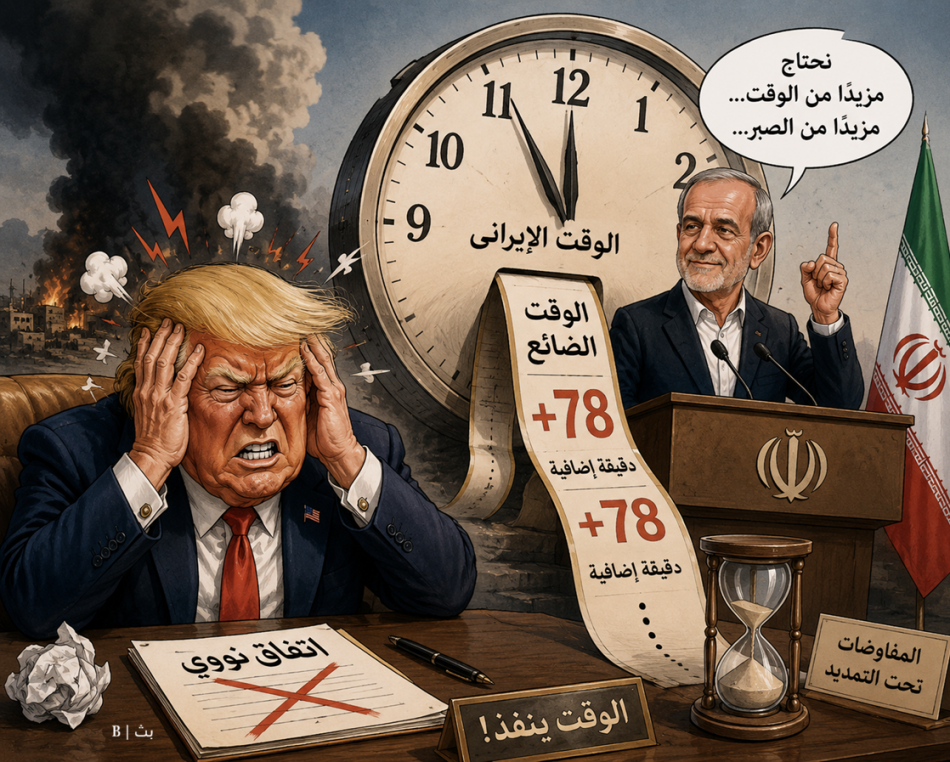
As the world awaits the possibility of war resuming, U.S. President Donald Trump spoke of a “very positive development” in talks with Iran, saying there is a good chance of reaching an agreement that would prevent Tehran from obtaining a nuclear weapon.
Trump stated that Washington would be satisfied with any deal guaranteeing Iran does not acquire nuclear arms, adding that he informed Israel of the decision to delay an attack in order to give diplomacy more time.
He also remarked that the United States is dealing with “half of the third tier” of Iran’s leadership — a statement reflecting the complexity within Iran’s decision-making structure — while reiterating the need for Tehran to provide a written commitment not to pursue nuclear weapons.
Meanwhile, Iranian President Masoud Pezeshkian said his country is facing unprecedented pressure due to war and sanctions, stressing that his government is working to contain the economic fallout despite limited resources.
He added that government officials have not taken any leave during the recent period, calling on Iranians to accept economic hardship and lower expectations. Some observers viewed the remarks as a sign of internal fractures within Iran’s ruling structure, or a tacit acknowledgment of the scale of losses and pressure facing the country.
B Analysis
The current scene appears to be a confrontation between:
last-chance diplomacy,
and the politics of time exhaustion.
Washington is trying to secure an agreement that would spare the region a major confrontation,
while allowing the U.S. administration to claim a strategic achievement without sliding into an open war that could ignite the Gulf, energy markets, and wider global tensions.
Tehran, meanwhile,
appears to be operating according to a long-standing but renewed strategy:
endurance,
buying time,
and managing pressure,
until the storm passes with the least possible damage to the structure of the regime.
Some analysts believe Pezeshkian’s remarks are not necessarily an admission of defeat,
but rather an attempt to psychologically and economically prepare the Iranian public for a prolonged period of pressure.
Observers of the Iranian system over the past four decades argue that the regime’s top priority has always been:
survival,
even if the state and society are forced to pay a heavy price.
The regime’s political doctrine is not built solely on governing the state,
but also on the concept of “revolutionary endurance,”
making the idea of full surrender incompatible with the system’s ideological structure.
At the same time,
the question becoming increasingly present on Day 78 is:
Is this merely a mutual political maneuver?
Or is the region truly approaching the final moments before a much larger explosion?
Because delaying war sometimes…
does not mean ending it,
but merely rearranging its timing and conditions.
Follow-up & Analysis | B | B