



Who Controls Whom?
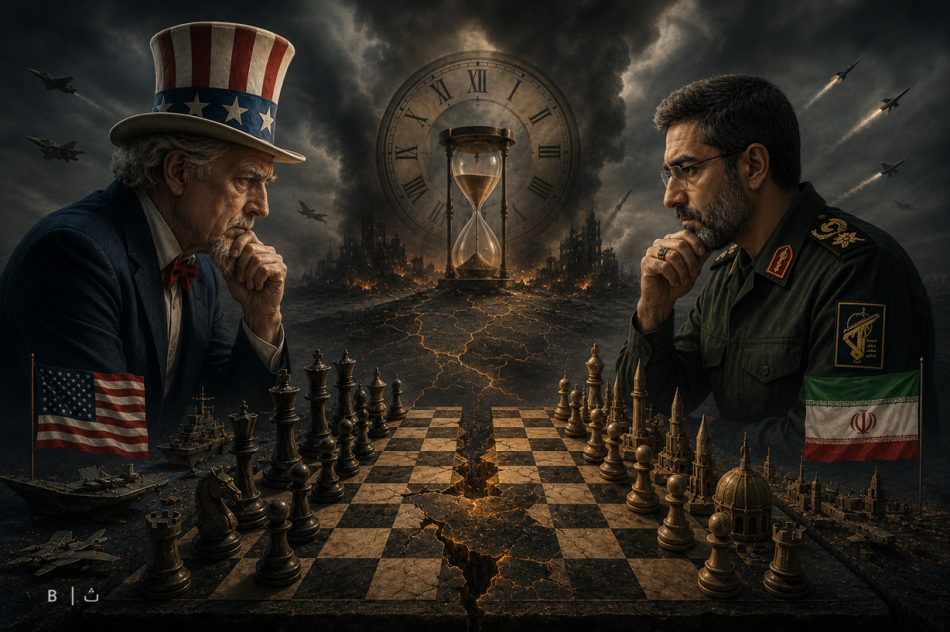
Prepared & Analyzed by | Strategic Media Department – B | بث
Negotiations with Iran appear — so far — to be moving at a pace closer to the rhythm preferred by Tehran.
Time passes
Statements are repeated
And Washington appears to be practicing “strategic patience”
Or at least that is how the scene appears.
But the question being strongly repeated is:
Is the United States being patient because it does not want a major explosion?
Or because it fears that the moment of decisive action could turn into chaos greater than the war itself?
And on the other side,
Has Iran successfully understood the American mindset,
Its way of thinking,
And its sensitivity toward long wars and the cost of post-regime-collapse scenarios?
Or does what is happening between the two sides go beyond public statements,
Into undeclared understandings and a carefully managed conflict behind the scenes?
The deeper question here is not only about missiles or negotiations…
But about the political psychology of both sides.
How does the American think?
And how does the Iranian think?
Historically, the American mindset tends toward:
rapid superiority,
economic pressure,
technological decisiveness,
and avoiding prolonged attrition once a war loses its strategic or public meaning.
But at the same time,
it carefully calculates:
the cost of chaos,
the image of failure,
and the impact of prolonged wars on the American الداخل, economy, and alliances.
The Iranian mindset, meanwhile,
appears more prepared to play on:
time,
long patience,
absorbing losses,
and managing tension without reaching total collapse.
Tehran understands that its opponent possesses overwhelming power…
But it is betting that power alone is not always enough to create decisive outcomes.
That is why what is happening now may not simply be:
a conflict between the strong and the weak…
But rather a struggle between:
those who possess power,
and those capable of exhausting that power through time and complex calculations.
What makes the scene even more ambiguous…
Is that the United States and Israel have already delivered severe blows to Iran,
and the escalation reached levels where Tehran appeared closer than ever to major exhaustion.
During that phase,
no party appeared capable of stopping Washington or limiting its military superiority.
Then suddenly…
The pace slowed down.
As if something had changed.
And here begins the most sensitive question:
Did the strategy actually change?
Or is what we are seeing part of the strategy itself?
American history in warfare reveals a recurring pattern:
overwhelming military superiority,
followed by a sudden shift from decisive action to crisis management,
and sometimes leaving the region in a state of vacuum or fragile balance.
This is why debate is intensifying today around several possibilities:
Will Washington truly stop at this point
and move into a phase of long-term containment?
Or will Iran be given time to reorganize internally
before a new and harsher round of pressure?
Or has the objective shifted away from fully toppling the regime,
toward containing it and reshaping its behavior within new balances?
And could we eventually witness broader international understandings — between the United States, China, Russia, and regional powers — imposing a new reality on Iran and the region,
whether through a grand settlement,
a gradual political transition,
or a restructuring of balances without total collapse?
At the same time,
another and more dangerous possibility remains:
That the region may enter a prolonged phase of:
non-decisiveness,
attrition,
and controlled chaos,
where the war is neither fully closed…
nor fully opened to its end.
And at its core,
the real question may not be:
Who is militarily stronger?
But rather:
Who possesses the ability to determine the shape of the ending…
and when it arrives?