



Day 74: Nuclear First
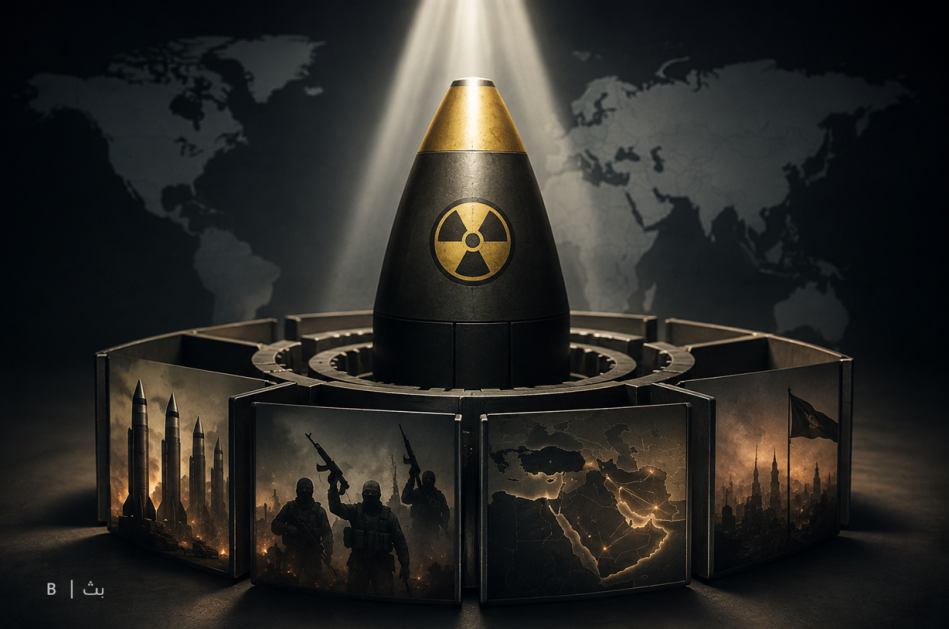
Follow-up & Analysis | B | بث
U.S. President Donald Trump departed Beijing after what he described as an important summit with Chinese President Xi Jinping, during which he announced “great trade agreements” and confirmed that the Iranian file featured prominently in the talks, alongside discussions surrounding the Strait of Hormuz.
According to Trump, Xi Jinping expressed willingness to help reopen the strait, while the U.S. president repeatedly stressed that Iran “cannot be allowed to possess a nuclear weapon,” noting that there was “significant convergence” with China on how to resolve the crisis.
Meanwhile, U.S. Central Command chief General Brad Cooper rejected reports claiming Iran still retains much of its missile capability, asserting that Iran’s defense industrial base linked to missiles, drones, and naval capabilities has declined by more than 90%.
The Brief
What stands out in recent American rhetoric…
is not only the repeated discussion of “weakening Iran,”
but Trump’s consistent focus on one issue in particular:
the nuclear file.
In most of his recent statements,
Trump repeatedly emphasized:
“Iran cannot have a nuclear weapon,”
while discussion surrounding:
missiles,
proxies,
regional influence,
and other conventional capabilities
has noticeably declined.
At the same time,
Washington continues to insist that Iran’s military infrastructure has suffered major setbacks,
particularly in:
missiles,
drones,
and naval power,
in an effort to portray the “traditional threat” as largely under control.
B | بث Analysis
The key question here is:
Why has the nuclear issue become the central headline in Trump’s rhetoric now?
One possible answer…
is that Washington may be seeking to redefine “the Iranian threat.”
After years in which the focus centered on:
militias,
proxy groups,
missiles,
and maritime threats,
the U.S. administration now appears to be narrowing the crisis into a more globally marketable issue:
nuclear weapons.
Because the “nuclear threat” is:
easier to politically communicate,
more internationally acceptable,
and less complicated than entering open-ended debates over regional influence and the complex dynamics of the Middle East.
The reduced emphasis on missiles and proxy forces may also carry an indirect message:
that Washington believes these capabilities have already suffered substantial blows,
or that they no longer represent the primary threat compared to preventing a nuclear transformation.
The United States may also view the remaining regional threats as manageable or containable later,
once the Iranian system itself has been sufficiently weakened,
or as threats that — despite their danger to the region — do not directly threaten core American interests to the same extent as the prospect of a nuclear-armed Iran.
Here, an important point emerges:
If Washington insists that Iran’s missile and naval capabilities have declined by more than 90%,
then the continued focus on the nuclear issue may indicate that:
“the real battle has become a battle over the future… not the present.”
In other words,
the United States does not merely seek to weaken Iran militarily,
but to prevent any future transformation into a nuclear deterrent power capable of reshaping the regional balance entirely.
In the background,
China’s role is becoming increasingly visible.
Trump’s remarks about Xi Jinping’s willingness to help reopen the Strait of Hormuz,
combined with talk of U.S.–Chinese convergence on Iran,
reflect how energy routes and maritime corridors have evolved into an international issue,
not merely a Middle Eastern crisis.
And if Russian President Vladimir Putin ultimately visits China,
the picture may gain even broader dimensions,
especially amid the growing overlap between:
energy,
war,
economics,
and the restructuring of global balances.
What Comes After Beijing?
Will Washington move toward greater pressure on Iran?
Toward military strikes?
Or will the situation remain within a framework of “managed tension” without final resolution?
Current indicators suggest that the United States does not want a large-scale regional explosion,
but neither does it want Iran to move freely.
Accordingly,
the next phase may involve:
stronger political and economic pressure,
deeper isolation,
and continued indirect military pressure,
without — at least for now — escalating into full-scale war.
At the same time,
China’s growing involvement in the Iranian file reflects an international desire to prevent instability in the Gulf from spiraling out of control,
particularly given the strategic importance of Hormuz to global energy markets and the world economy.
And if Putin’s visit to China is confirmed,
the Iranian crisis could evolve into part of a much broader picture:
the reshaping of international balances,
not merely the management of a regional dispute.
At a deeper level,
the coming stage may not be about “rapid decisiveness”…
but rather:
long-term pressure,
balance management,
preventing a major explosion,
while keeping all options open.
The Broader Picture
Washington appears to be shifting the conflict with Iran from:
“an open-ended influence war”
to:
“a battle to prevent nuclearization.”
Yet the question repeatedly surfacing across the region remains:
Has the threat itself truly changed…
or has only the way it is politically and media-wise presented changed?
Who Controls Whom?
Iranian Foreign Minister Abbas Araghchi called on the United States to “be patient,” stressing that negotiations will take time, in a statement reflecting Tehran’s reliance on time itself as part of managing the conflict.
The Iranian message appears clear:
the longer negotiations continue,
the lower the chances of rapid decisiveness,
and the wider the room for political and economic maneuvering.
But the question increasingly raised across the region is:
If Washington possesses such overwhelming military and technological superiority,
why is Trump being patient?
Here lies the core of the picture.
What appears to be a contradiction between:
American power,
and prolonged patience,
may not be a contradiction at all…
but rather a deliberate management of a sensitive space between:
pressure,
deterrence,
and preventing a full-scale regional explosion.
The United States does not seem focused solely on “striking Iran”…
but rather on:
containing it,
preventing its transformation into a nuclear power,
while avoiding a wider regional chaos whose consequences may become uncontrollable.
Especially after the experiences of:
Iraq,
Afghanistan,
and prolonged wars that ultimately carried costs greater than their outcomes.
At the same time,
Iran appears fully aware of this sensitivity,
and is attempting to turn “time” itself into a tool of pressure and attrition.
The situation therefore increasingly resembles a struggle over:
who can impose their own timing on the other?
Washington holds the power,
while Tehran tries to manage time.
And in modern conflicts…
time itself can sometimes become a weapon no less important than missiles.
The question therefore remains open:
Who ultimately prevails…
the power capable of decisive action,
or the time that continues to delay it?