


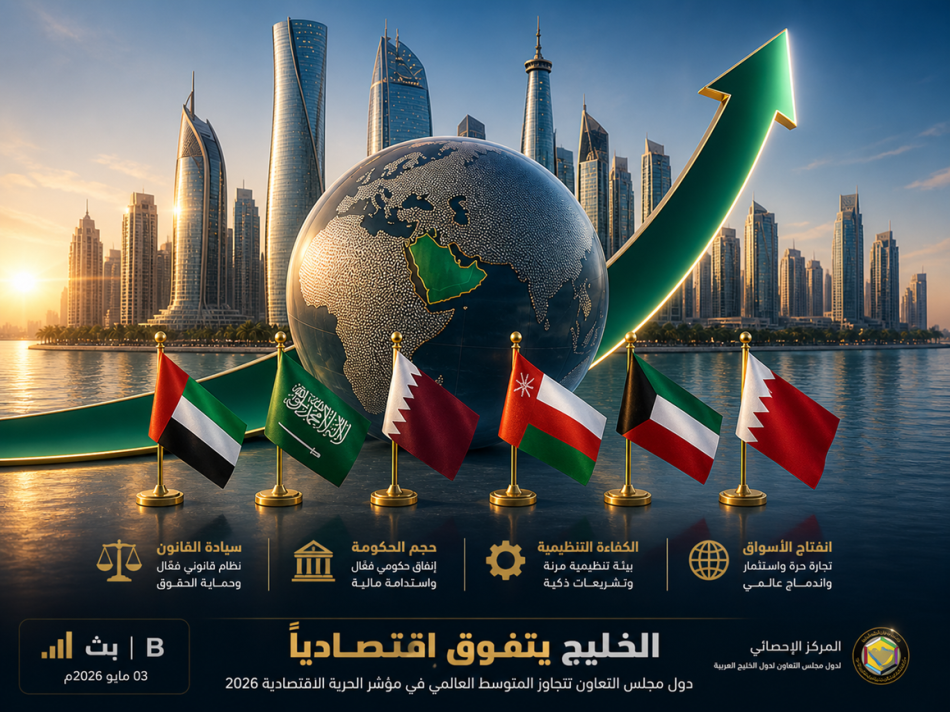
Gulf Outperforms Economically
Riyadh | B | بث
May 3, 2026
—
Gulf Cooperation Council (GCC) countries continue to strengthen their position in global economic indicators, recording an advanced performance in the 2026 Economic Freedom Index. Surpassing the global average by a notable margin, this reflects the accelerating pace of reforms and the effectiveness of economic policies across the region.
—
Overview
Data released by the GCC Statistical Center showed that the GCC’s average Economic Freedom Index reached 66.9 points, exceeding the global average of 59.9 by nearly 7 points.
This performance highlights a high level of economic openness and an improved business environment, as regional economies undergo rapid structural transformations.
All GCC countries recorded either improvement or stability in their index scores between 2025 and 2026, with only limited variation among them, confirming the continuity of reform-driven policies and economic consistency.
At the Arab level, GCC countries ranked among the top seven, reinforcing their position as the most economically open economies in the region.
The index, ranging from 0 to 100, is measured across four main pillars: rule of law, government size, regulatory efficiency, and market openness. It is based on 12 sub-indicators covering 184 countries worldwide.
—
B Reading
What these figures reveal goes beyond numerical outperformance.
It reflects a deeper transformation in the Gulf’s economic philosophy:
- A shift from dependency to diversification
- From traditional management to modern governance
- From relative closure to calculated openness
The convergence in performance across GCC countries is not merely similarity.
It signals an emerging economic integration, driven by shared vision and aligned interests.
In a world being economically reshaped,
growth alone is not enough—attractiveness is the real advantage.
—
Conclusion
The Gulf is not just raising indicators.
It is redefining its position in the global economy.
The next question is no longer: Will this outperformance continue?
But: How will it be leveraged to build broader economic influence?