



Trump in Miami: Alliance of Power .. Praises the Crown Prince, Calls Him a “Warrior”
Miami | BETH
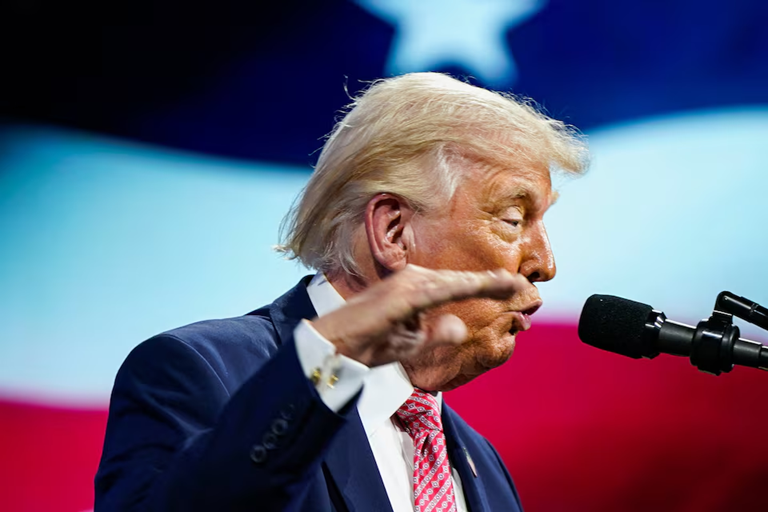
The speech delivered by U.S. President Donald Trump in Miami was not merely a remark at an investment forum,
but a direct presentation of a new equation combining power and economics.
In his remarks, Trump made his striking statement:
“Cuba is next,”
adding that U.S. operations in Iran and Venezuela have achieved “great successes.”
He also confirmed that he informed Tehran of the need to allow ships to pass through the Strait of Hormuz, noting that “Iran is negotiating” with the United States.
In the context of relations with the Kingdom, Trump praised Crown Prince Mohammed bin Salman, describing him as a “warrior,” and highlighted the role of Gulf leaders in confronting challenges. He also mentioned Yasir Al-Rumayyan, signaling the weight of sovereign capital in the broader equation.
Trump also directed several messages to the American domestic audience,
aiming to reinforce the image of his administration as a decisive force that combines security and economic strength.
He emphasized what he described as “successful” military operations,
linking them directly to securing energy routes and stabilizing markets,
and pointed to significant investment flows from U.S. allies, particularly Gulf countries.
This was not incidental,
but a deliberate message that foreign policy is not managed solely for political purposes,
but to achieve direct economic outcomes that support growth and stability.
Through these statements,
Trump was not merely describing reality,
but reshaping it.
Overview
In his speech, Trump spoke about what he described as “successful” U.S. operations, referring to Iran and Venezuela, and asserting that Washington is imposing a new reality in the region.
He also reiterated his notable phrase:
“Cuba is next,”
a statement carrying multiple meanings, ranging between direct threat and strategic ambiguity.
In this context, he confirmed that he had urged Iran to open the Strait of Hormuz, pointing to ongoing negotiations without official details.
Saudi Arabia at the Core of the Speech
The Kingdom’s presence in the speech was not ceremonial,
but central to the message.
Trump praised Crown Prince Mohammed bin Salman, describing him as a “great man” and a “warrior,” placing him among leaders who faced pressure with resilience.
He also called on Yasir Al-Rumayyan by name, highlighting the role of sovereign capital, and emphasized that relations with Saudi Arabia are no longer purely political, but deeply economic and strategic.
He went further by linking the Gulf region as a whole to massive investment flows, indicating that it has become part of the global influence equation.
BETH Analysis
The speech was not directed at a single audience,
but crafted to be read on multiple levels:
For the American domestic audience:
success in war and inflow of investments.
For allies:
a partnership that goes beyond protection to shared influence.
For adversaries:
pressure messages delivered through calibrated language between clarity and ambiguity.
More importantly, the platform itself was part of the message:
A Saudi investment forum
An American speech
With military and economic substance
This is not coincidence,
but the construction of a new scene:
Alliances are no longer measured only by weapons,
but by the movement of capital.
In Miami,
the discussion was not only about war,
nor only about investment.
It was about a phase where geography is managed
through politics
and capital
together.
The U.S. President Donald Trump delivered a speech at the “FII Priority Miami” summit, organized by the Future Investment Initiative, which was held in the U.S. city of Miami over two days.
The summit was held within the framework of an investment forum that brings together Saudi Arabia and the United States, with the حضور of senior officials and international investors. Its sessions focused on discussing the fundamental transformations reshaping the global economy, and the role of capital in adapting to a volatile environment driven by technology and geopolitics.
The sessions addressed multiple topics, most notably the future of investment, changes in global markets, the impact of artificial intelligence, as well as challenges related to energy and supply chains.
The summit is considered a platform that brings together world leaders, investors, and decision-makers, with the aim of strengthening economic partnerships, exploring investment opportunities, and formulating shared visions to deal with global economic transformations (more details about the summit).