
Washington Sanctions the International Criminal Court
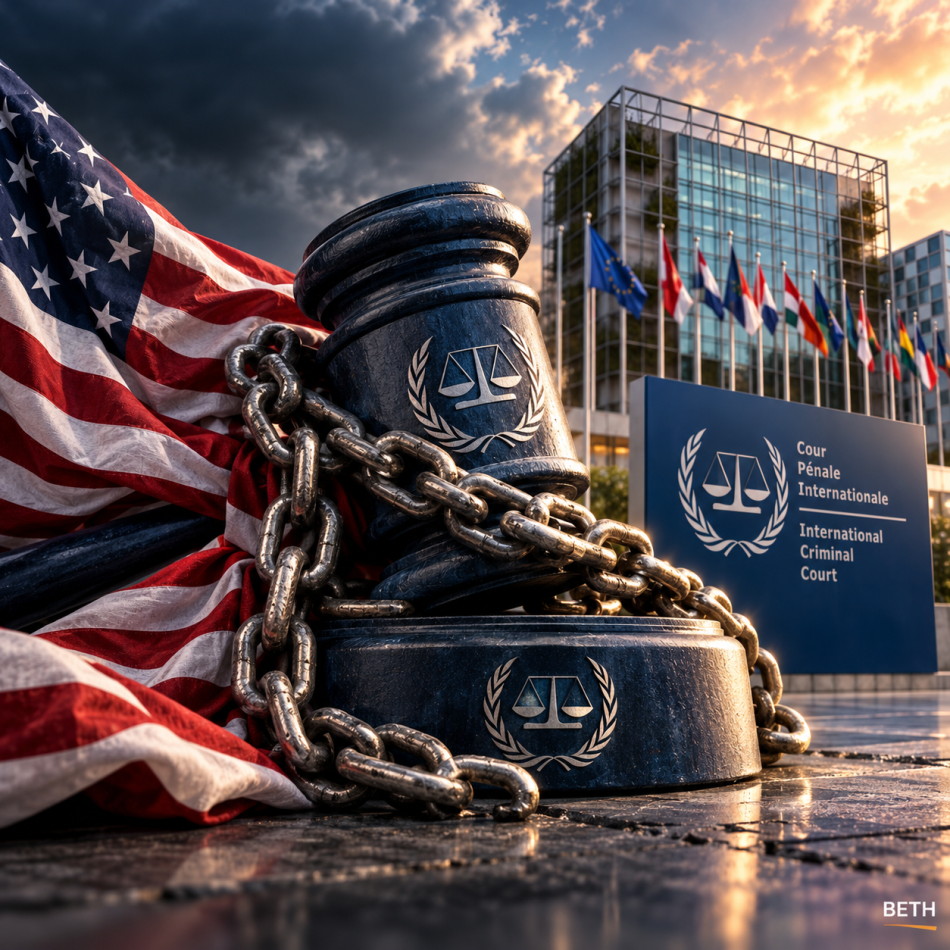
The United States imposes sanctions on the International Criminal Court itself for the first time, following a series of sanctions targeting its judges and prosecutors; the decision provides an effective grace period of about six months, but opens a direct confrontation between Washington, the Court, and its European allies
October 9, 2026
Prepared and Analyzed by | Strategic Media Management – BETH Agency
The United States today imposed sanctions on the International Criminal Court itself, in an unprecedented step that goes beyond targeting individual judges and prosecutors to target the institution as a whole. U.S. Secretary of State Marco Rubio said Washington would prohibit transactions with the Court, reiterating his country’s rejection of subjecting U.S. officials or military personnel to the jurisdiction of a judicial body that the United States has not joined.
The move follows earlier U.S. sanctions against a number of judges and prosecutors associated with the Court. The new decision, however, escalates the confrontation to a different level, as it targets the Court’s ability to operate, secure funding, and deal with institutions and individuals subject to the U.S. financial system.
Despite the severity of the decision, Washington granted a set of exemptions that effectively amount to a grace period of nearly six months, which it said was intended to give member states an opportunity to address U.S. concerns. The period can be adjusted depending on what Washington considers progress or failure in responding.
The Court rejected the decision, describing it as an attack on an independent judicial institution and an attempt to obstruct international justice. It stressed that it was established under an international treaty and currently operates with the mandate of 125 member states to investigate war crimes, crimes against humanity, genocide, and the crime of aggression.
International reactions came quickly. European countries, Canada, Japan, and Britain rejected the move, while the European Union described the sanctions as regrettable and pledged to support the Court’s continued work. The UN Secretary-General also said the decision represented a blow to international criminal justice.
Why Now?
The dispute between Washington and the Court is not new. The United States is not a party to the Rome Statute and rejects granting the Court jurisdiction over its nationals, while investigations involving the United States and Israel have increasingly strained relations between the two sides. Washington says the Court is exceeding its authority, while the Court maintains that its jurisdiction is grounded in international law and the authority granted by its member states.
But the timing of today’s decision added another dimension.
It came just hours after South African judge Navi Pillay was announced as the winner of the 2026 Nobel Peace Prize. Pillay is a former judge at the International Criminal Court and one of the most prominent advocates of international judicial institutions. Earlier today, she warned that international law and judicial institutions were facing increasing political pressure.
This paradox brings directly back into focus the question raised in BETH’s Nobel report today: Can peace prizes and legal institutions protect the very idea of peace when they come into confrontation with political power?
Nobel Report: Does Nobel Make Peace?
BETH Reading
The issue is larger than a U.S. dispute with a court in The Hague.
It is a confrontation between two concepts:
The first holds that national sovereignty sets limits on the authority of international institutions.
The second holds that some crimes should be subject to international accountability when national systems are unable or unwilling to act.
For that reason, the impact of the sanctions will not be measured only by the Court’s ability to pay salaries or conduct investigations, but by whether its 125 member states can preserve its operational independence in the face of the power of the U.S. financial system.
The clearest paradox came on the same day:
The world awards the Nobel Peace Prize to a judge who defended international justice, while the world’s most powerful country imposes sanctions on the institution in which she once served.
And here the question becomes broader than the Court itself:
Who protects international justice when justice itself becomes a party to the conflict?