

Nobel.. Does It Make Peace?
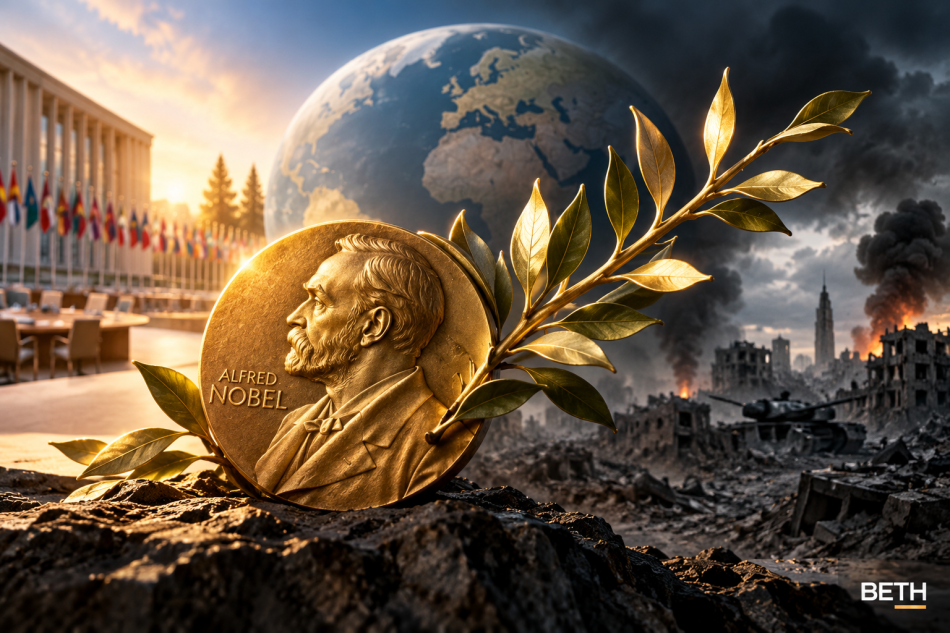
Navi Pillay’s winning of the 2026 Nobel Peace Prize revives the old question: does the prize merely reward peacemakers, or does it seek to give them influence in a world where wars have never stopped?
October 9, 2026
Prepared and Analyzed by | Strategic Media Management – BETH Agency
South African human rights advocate and judge Navi Pillay won the 2026 Nobel Peace Prize in recognition of her career defending international law, human rights, and accountability for war crimes, after decades of work in international justice and the United Nations. The award will be presented in Oslo on December 10.
How Did the Prize Begin?
The prize traces back to Swedish industrialist and chemist Alfred Nobel, inventor of dynamite, who signed his final will on November 27, 1895, allocating most of his fortune to establish five prizes awarded to those who provide “the greatest benefit to humankind.”
In the peace category, the will called for honoring those who work for fraternity between nations, the reduction of standing armies, and the holding and promotion of peace congresses. Nobel died in 1896, and the prize was awarded for the first time in 1901, shared by Red Cross founder Henry Dunant and French peace activist Frédéric Passy.
The Peace Prize is awarded in Oslo, unlike the other Nobel prizes, which are administered by Swedish institutions. The winner is selected by five members appointed by the Norwegian Parliament. Nobel left no definitive explanation for why he specifically entrusted the Peace Prize to Norway.
Nobel also had an early interest in peace movements, and he was influenced by his relationship with Austrian activist Bertha von Suttner, who later became one of the most prominent figures in the peace movement and won the prize in 1905.
How Is the Winner Celebrated?
The Nobel Peace Prize is presented on December 10 every year, the anniversary of Alfred Nobel’s death, during an official ceremony at Oslo City Hall. Members of the Norwegian royal family attend, along with representatives of the government, parliament, and diplomatic corps, as well as invited guests and civil society figures. Attendance approaches 1,000 people.
The program begins with a speech by the chair of the Norwegian Nobel Committee explaining the reasons for the selection. The winner then receives the Nobel medal and diploma, before delivering the “Nobel Lecture,” presenting their vision and message of peace. The ceremony also includes a number of artistic performances.
That same evening, the Nobel Peace Prize Banquet is held at the Grand Hotel in central Oslo, attended by around 250 guests, including members of the Nobel Committee, the president of parliament, the prime minister, public figures, and guests of the laureate.
The celebrations usually begin on December 9 with a press conference and official meetings, and continue on December 11 with the Nobel Peace Forum and the opening of the annual exhibition dedicated to the prize.
What Does the Winner Receive?
The Nobel Peace Prize laureate receives three main things:
The Nobel gold medal, an official diploma specially designed for the laureate, and a cash award.
The full value of the prize currently stands at 11 million Swedish kronor, equivalent to roughly one million U.S. dollars depending on the exchange rate, and is divided if the prize is shared by more than one laureate.
Trump and the Nobel Prize
U.S. President Donald Trump has repeatedly returned to the debate surrounding the prize in recent years, after governments and public figures said they had nominated him, including parties in Pakistan, Israel, and Cambodia. But the Nobel Committee does not announce or confirm the names of nominees before a decision is made; nomination records remain confidential for 50 years. The name of the winner, South African human rights advocate and judge Navi Pillay, was officially announced today as the 2026 Nobel Peace Prize laureate. What is officially known is that this year’s prize received 287 nominations from individuals and organizations.
Trump has spoken repeatedly about the prize and has said that his role in international agreements and settlements merits recognition. But this year, the Nobel Committee selected Pillay. The committee does not normally explain why any nominee was not chosen; it only explains the reasons for selecting the winner.
Does It Encourage Peace?
This is the more important question.
The Nobel Peace Prize cannot stop a war by decree, does not command an army, and cannot impose an agreement on warring parties. Its power is symbolic, political, and moral; it gives its recipient international legitimacy, draws attention to a cause, and may protect an activist or institution from being forgotten, while giving them greater influence and resources.
What is notable is that the Nobel Committee itself has historically acknowledged that it does not look only at past achievement, but sometimes also considers the expected positive impact of the prize on the peace process. In other words, Nobel does not always seek merely to reward peace already achieved; at times, it tries to push forward a peace that has not yet been completed.
But history offers the other side.
Since humankind discovered gunpowder, and later the cannon, the tank, the missile, and the drone, war has never disappeared. The Nobel Prize itself has lived through two world wars, civil and regional wars, arms races, and conflicts that remain active to this day.
Indeed, the prize was not awarded in 19 years since its establishment, including years during the two world wars, in an image that at times sums up the inability of the idea of peace to keep pace with the expansion of war.
BETH Reading
If Nobel’s success were measured by its ability to end wars, the prize would not have fulfilled its mission.
But perhaps that is not its real standard.
The prize does not create peace on its own; it gives a voice to those trying to make it.
Since 1901, wars have not stopped, but neither have efforts to prevent them, negotiate their end, hold perpetrators accountable, and help their victims.
And here lies the Nobel paradox:
The prize was born from the fortune of a man whose name became associated with explosives, and then became the world’s most famous reward for those trying to keep humanity away from explosives.
And after 125 years, the question remains open:
Is Nobel a prize for those who make peace.. or an annual reminder that the world still needs people who can make it?