



False Bomb Threats Disrupt European Air Travel
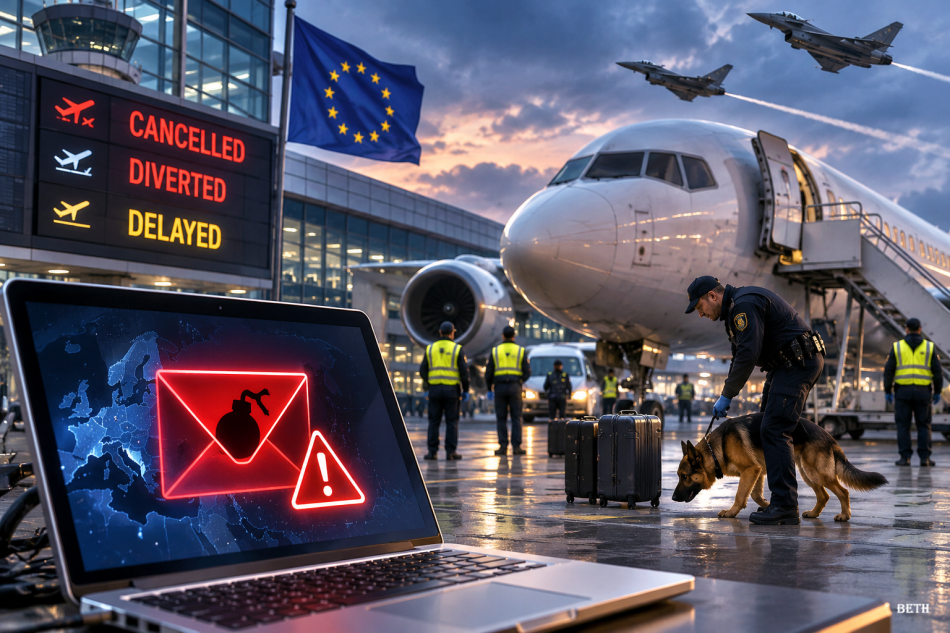
More than 30 flights receive bomb threats in one week, prompting fighter jet deployments and heightened security measures. No explosives have been found, raising questions about who may be behind the disruption.
RIYADH | BETH
November 5, 2026
European civil aviation has faced an unusual wave of bomb threats targeting passenger aircraft, forcing flight diversions, emergency landings, aircraft searches, and military fighter jet deployments, despite no explosives being found in the cases where authorities have announced inspection results.
At least 32 flights have been affected since Monday, including 27 or more on Thursday alone, according to the latest available figures. The disruptions involved flights connected to the United Kingdom, France, Italy, Spain, Poland, Bulgaria, the Czech Republic, Austria, and other European countries.
Among the most notable incidents was the diversion of a flight from Dublin to Rome to a French military airbase. Fighter jets also escorted civilian aircraft in Italian and Bulgarian airspace, while other flights were diverted to alternative airports or prevented from departing until security inspections were completed.
How Are the Threats Delivered?
Preliminary investigations indicate that several warnings were sent through anonymous emails to airports, airlines, and aviation operators, claiming that explosives had been placed aboard specific flights.
When a threat is received, security authorities assess its credibility and take appropriate precautions, ranging from suspending departures and evacuating passengers to diverting aircraft or providing military escorts, followed by searches of the aircraft and baggage.
There has been no confirmed cyberattack targeting aircraft navigation or flight control systems. An electronic threat delivered by email is fundamentally different from a cyberattack directed at aviation infrastructure or technical systems.
Why Target Civilian Aircraft?
Civil aviation is an exceptionally sensitive sector. Even a false threat can disrupt a flight, mobilize security agencies, interfere with airport operations, and impose financial losses on airlines.
Targeting flights across several countries also amplifies the psychological and media impact while testing the ability of European security authorities to coordinate their responses.
Who Is Behind the Threats?
European authorities have not identified those responsible, nor have they presented evidence linking the incidents to any particular country or organization.
Possible explanations include individual acts, copycat threats, or coordinated efforts intended to disrupt civilian transportation.
Experts are also examining whether the incidents could be associated with what are known as hybrid operations, which use relatively low-cost methods to destabilize or disrupt countries without direct military confrontation.
However, any suggestion that Russia or Iran may be involved, given current international tensions, remains a possibility rather than an established investigative finding.
The European Union has activated an aviation security information-sharing mechanism, while national authorities continue investigating the origins of the messages and whether the incidents are connected.
BETH Analysis | No Explosives, Yet Real Consequences
These incidents expose an unequal security equation: an unidentified individual can issue a threat at minimal cost, while governments and airlines must commit substantial resources to ensuring the safety of hundreds of passengers.
This is where the real danger lies. Successful security measures may protect aircraft and passengers, but they do not eliminate operational and economic losses or the psychological impact on travelers.
Nevertheless, the timing and similarity of the threats are not sufficient to establish that a single organization is coordinating them. Determining responsibility requires tracing the origins of the messages and identifying any connections between them.
The central question is whether Europe is facing a series of similar individual threats, or whether someone has discovered a way to disrupt air travel without carrying out an actual attack.
The answer will determine whether the continent is experiencing a temporary wave of false alarms or confronting an emerging security pattern that requires new approaches to prevention and response.
Prepared and Analyzed by | Strategic Media Department – BETH News Agency