



Swift: A Scientific Journey Ends with a Fall
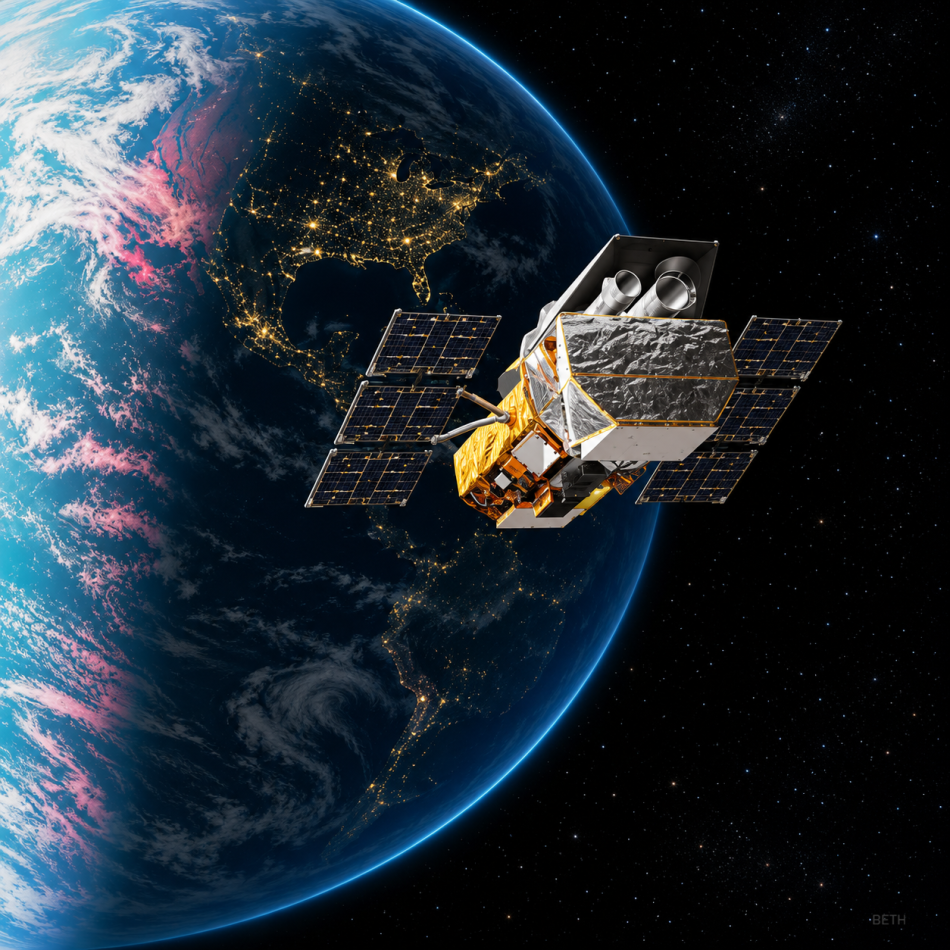
After nearly 22 years of observing the universe’s most powerful explosions, NASA ends the mission of one of its most important space observatories following a failed attempt to save it from its gradual descent toward Earth.
Riyadh | BETH
November 1, 2026
NASA officially ended the mission of the Swift space observatory on October 23, 2026, after nearly 22 years of scientific operations. The spacecraft exceeded its planned operational lifetime by more than tenfold and contributed to discoveries that transformed scientists’ understanding of powerful cosmic explosions, stellar deaths, and the formation of black holes.
The Beginning
Swift was launched on November 20, 2004, through a collaboration between the United States, the United Kingdom, and Italy. Its primary mission was to detect gamma-ray bursts, among the most energetic phenomena known in the universe.
Originally designed to operate for just two years, the observatory continued working for almost 22 years. Equipped with three scientific instruments, it detected cosmic explosions and rapidly redirected its telescopes toward their sources to study their afterglows in X-rays, ultraviolet, and visible light.
In 2018, it was renamed the Neil Gehrels Swift Observatory in honor of the American astrophysicist who led its development.
Extraordinary Achievements
Throughout its mission, Swift detected more than 2,000 gamma-ray bursts and over 1,400 supernovae, providing valuable insights into black holes, stellar explosions, and neutron star mergers.
It also helped the Hubble and James Webb space telescopes, along with ground-based observatories, direct their instruments toward unexpected cosmic events.
Swift's importance extended beyond the number of discoveries it made. Its exceptional ability to detect cosmic phenomena and rapidly alert scientists to their locations enabled astronomers to observe events that would otherwise have been difficult to study.
Why Did Swift Begin to Fall?
Swift operated in low Earth orbit, gradually losing altitude over the years because of atmospheric drag from the upper layers of Earth's atmosphere.
Increased solar activity caused these atmospheric layers to expand, intensifying drag and accelerating the spacecraft's orbital decay. Swift lacked a propulsion system capable of restoring it to a safer altitude.
The Final Rescue Attempt
In July 2026, the robotic spacecraft LINK, developed by Catalyst Space, was launched on an extraordinary mission to approach Swift, capture it, and raise its orbit to extend its operational life.
However, LINK experienced attitude-control failures that prevented the rescue operation from proceeding.
On August 19, NASA announced that the attempt to raise Swift's orbit had been abandoned. LINK's technical mission subsequently ended in September.
The End of the Mission
By October 20, 2026, Swift's altitude had fallen to approximately 275 kilometers, and increasing atmospheric drag made it impossible to maintain the precise orientation required by its scientific instruments.
The observatory recorded its final scientific observations that day, before NASA formally ended the mission on October 23.
The decision brought to a close a scientific journey that began in 2004. Swift's data contributed to thousands of scientific studies and will remain available to researchers long after the spacecraft disappears from orbit.
When Will Swift Fall to Earth?
According to estimates available on November 1, 2026, Swift is expected to re-enter Earth's atmosphere within the coming days, potentially between November 4 and 6, although the precise timing remains uncertain.
Most of the observatory is expected to burn up during atmospheric re-entry, although some particularly dense components may survive.
BETH Analysis | An Ending and a Beginning
The loss of Swift does not represent a scientific failure. Rather, it marks the conclusion of one of the most successful space missions, having exceeded its expected lifetime by more than two decades.
More importantly, the unsuccessful rescue attempt raises a new question for space agencies: Could repairing observatories and satellites in orbit, and extending their operational lifetimes, become a more economical alternative to manufacturing and launching replacements?
Swift's mission has ended, but its discoveries will endure, as a new chapter begins in exploring how to protect space observatories from a similar fate.
Prepared and analyzed by | Strategic Media Department – BETH News Agency